
How To Build Consistent Back-of-House Restaurant Training
How Just Salad Built Consistent Back-of-House Training Across Every Location
Back-of-house training is the backbone of every multi-location restaurant—and it's often the hardest to get right. The kitchen team operates away from guests, under time pressure, and with a rotating cast of team members who may be new to both the job and the technology you're asking them to use. Consistency suffers. Food quality drifts. And the gap between your best and worst locations widens.
This article is drawn from a live Opus Office Hours session featuring Alex Chavez, VP of Training and Labor Management at Just Salad. Join us for the next session →
Alex Chavez has spent the last four years closing that gap. The result: 95% of managers and kitchen staff promoted from within last year, an average manager tenure of 3.5 years, and a prep team that knows every item on the menu—not from memory, but from a training system that's always within reach.
Here's how he built it.
Start with a Philosophy, Not a Platform
Before Just Salad implemented any training technology, they established a guiding framework. Just Salad's founder introduced Alex to what he calls the "three C's": Culture, Consistency, and Connection.
"When it comes to back of the house, the biggest C was consistency," says Alex. "You can have great culture in your stores. You can have great connection with guests. But the meat of the bone—the backbone of the store—is the back of the house. And we put heavy focus on consistency when building the training structure. For us, consistency is food safety and food quality."
Every training decision at Just Salad is filtered through those three C's. That clarity is what makes the program scalable—because trainers, managers, and prep team members all understand why the training exists, not just what it covers.
Operational Buy-in: Make Training Part of the Culture, Not a Checkbox
The most common back-of-house training problem isn't a content problem. It's a buy-in problem. Team members complete courses because they have to, not because they see value in them. That attitude shows up in how they perform on the line.
Just Salad solved this by embedding training into their culture from day one—before a new hire ever steps into the back of the house.
💡 "Opus is part of our culture," Alex explains. "From hiring to recertification, Opus is shown to our teams as our training culture. This leads them to adapt and have the mindset that Opus will be part of their daily work."
That mindset is reinforced from the top. At Just Salad, everyone from the COO to Restaurant Training Leads (RTLs) gets recertified through the same courses as the prep team. When leadership participates in the same certification process, the message is unmistakable.
"The biggest way we got buy-in was our team seeing that from our COO down, they know the procedure. They do the procedure in store. And they come out to do the certification process as well."
The payoff shows up in career growth. When team members advance into management, they're already fluent in the platform and the protocols. "When promoted, they are certified through Opus and that mindset is carried throughout their management career," Alex says. "Use Opus, guide your teams through Opus, and continuous learning through Opus."
Structure the Curriculum Around Certification, Not Completion
Just Salad's back-of-house training isn't a single long course—it's a structured curriculum organized by the categories the prep team actually works through:
- Oven items
- Greens
- Proteins
- Cheeses
- Bread
Team members get certified in each section before they set foot in the kitchen. Every prep item—cold or hot—has its own course, and every course is built around a 2-to-3-minute video. That constraint wasn't arbitrary.
"We found employees losing interest when there were too many slides or the video was too long," Alex says. "So that's when we started doing mini cutouts of what each procedure was."
Micro-learning course structure for BOH training
Each course follows a consistent structure:
- What the finished product should look like
- The tools needed
- The ingredients and recipe
- A food safety section covering storage times, hot holding requirements, and common mistakes
Video content is prioritized over static PDFs because, as Alex puts it, "once they do the video process certification part through Opus, they're able to do the procedure much easier."
One deliberate design choice worth noting: no quiz questions on recipes. "We don't expect our team members to memorize the recipe. That's why there's no questions relating to the recipe." Instead, the kitchen prep book lives on a training iPad at every store. When a team member is building a dish, the reference is right there—accuracy without pressure.
Sequence Digital Training Around the Rhythm of the Floor
A common question in multi-location training: which comes first, digital modules or shoulder-to-shoulder instruction? At Just Salad, the answer is clear—Opus first, then hands-on. And the hands-on happens at the right moment in the shift, not whenever it's convenient.
New prep team members complete the full four-hour digital certification before they touch anything in the kitchen. Once certified, hands-on training begins during the slower dinner rush—when an RTL or manager can give dedicated time without the chaos of the lunch crush.
"The goal is they come in and do their Opus training. And then time is set forth during the slower period where our prep team comes in and starts learning the hands-on procedure—because it's slower and we can dedicate that time to them, very hands-on, with the KTO or manager present."
This sequence works because digital training isn't trying to replace hands-on practice—it prepares team members to absorb it more effectively. They already understand the procedure, the tools, and the food safety requirements. Floor training becomes application, not explanation.
One practical note on scheduling: training happens within scheduled shifts, during downtime. "Training is in their downtime. There's no added cost"—no early clock-ins, no extended shifts, no added labor.
Treat Ongoing Training as Your Quality Control System
Initial certification is the baseline. Consistency at scale requires ongoing training built into daily operations. At Just Salad, that looks like:
- Regular store visits: RTLs are tasked to come in twice a week to observe the full prep procedure from start to finish—from greens through proteins—live in the store.
- Course reassignment, not reprimand: When something is done incorrectly, the response is to reissue the course. "If we see something that's not done correctly, we reissue the course to them. It's just an ongoing training process."
- Topic of the week: One prep item gets focused attention across the week. Managers recertify everyone on that item, visit every store, and confirm it's being executed correctly.
- Pre-rush mini meetings: RTLs run brief stand-ups before every rush to keep standards fresh without pulling people off the floor.
The consistent thread across all of it: standards are reinforced through the same tools and the same courses, at every level of the organization.
What the Results Look Like
A training program rooted in culture, not compliance, produces different outcomes. At Just Salad:
- 95% of manager and kitchen staff promotions came from within last year
- 3.5 years is the average manager tenure
- Some managers have been with the company for thirteen to sixteen years
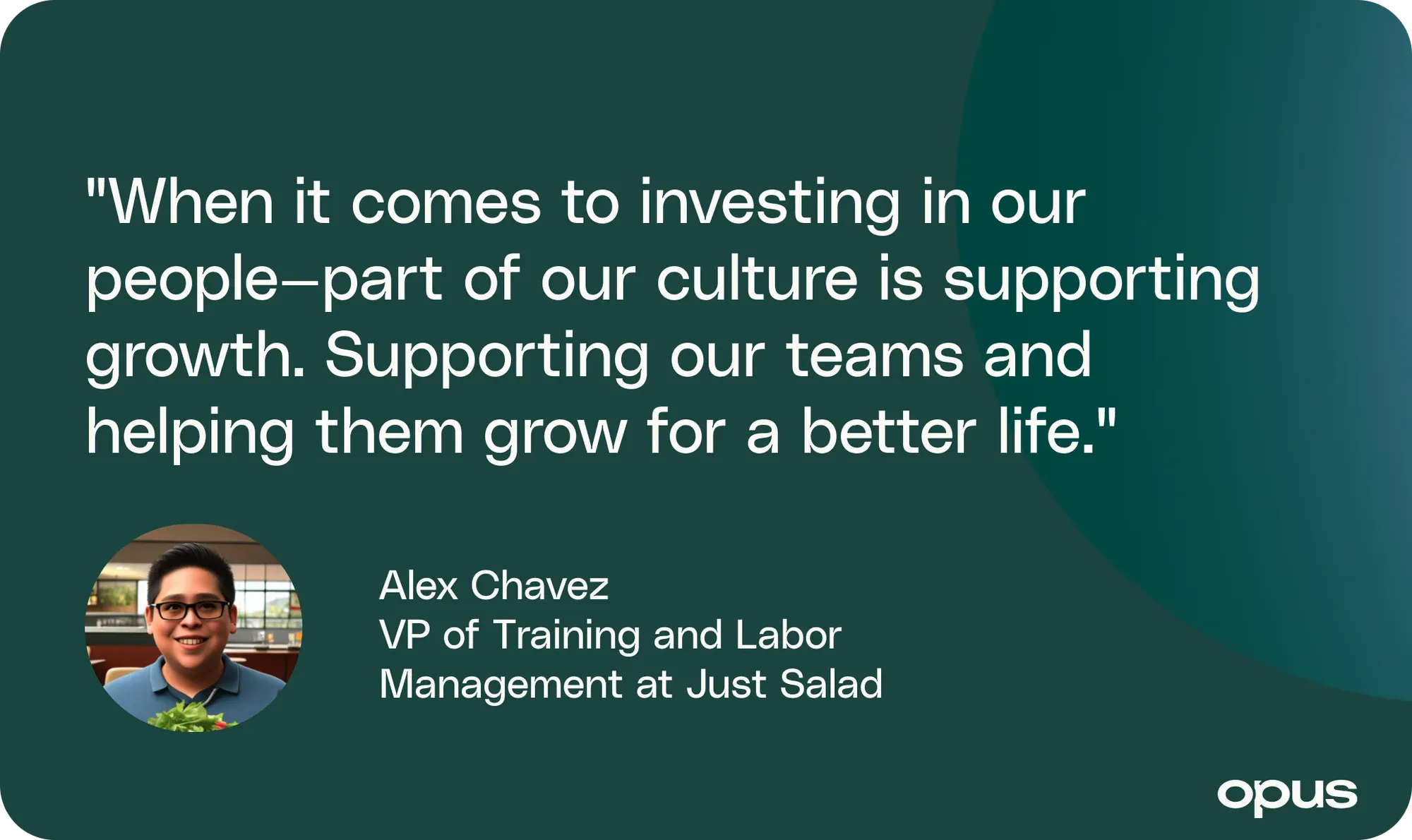
💡"When it comes to investing in our people—part of our culture is supporting growth. Supporting our teams and helping them grow for a better life."
Alex Chavez, VP of Training and Labor Management at Just Salad
That kind of retention doesn't happen by accident. It happens when team members feel seen, trained well, and connected to something larger than a task list. The three C's—Culture, Consistency, Connection—aren't just a philosophy. They show up in every course, every certification, and every recertification.
Bringing This to Your Operation
Back-of-house training is only as strong as the system behind it. Here's what Just Salad's approach comes down to in practice:
- Ground your training in a clear framework. Whether it's three C's or something else, your team members need to understand why the training matters, not just what they're required to complete.
- Build buy-in from the top down. If leadership participates in the same certification process as the prep team, the message is unmistakable.
- Make training a cultural constant, not a one-time event. From first shift to promotion to recertification, the platform should be a consistent presence—not something that disappears after onboarding.
- Keep courses short, structured, and video-first. Two to three minutes per concept, one item at a time. Remove memorization pressure by keeping reference materials accessible on the floor.
- Use reassignment, not reprimand. When standards slip, reissuing a course is faster, less adversarial, and more effective than starting over.
The back of the house is the backbone of the store. Train it accordingly.
Want to see how operators like Just Salad build training programs that drive consistency across every location? Request a demo →