
What Three Veterans Think Is Really Broken in Hospitality Training Operations
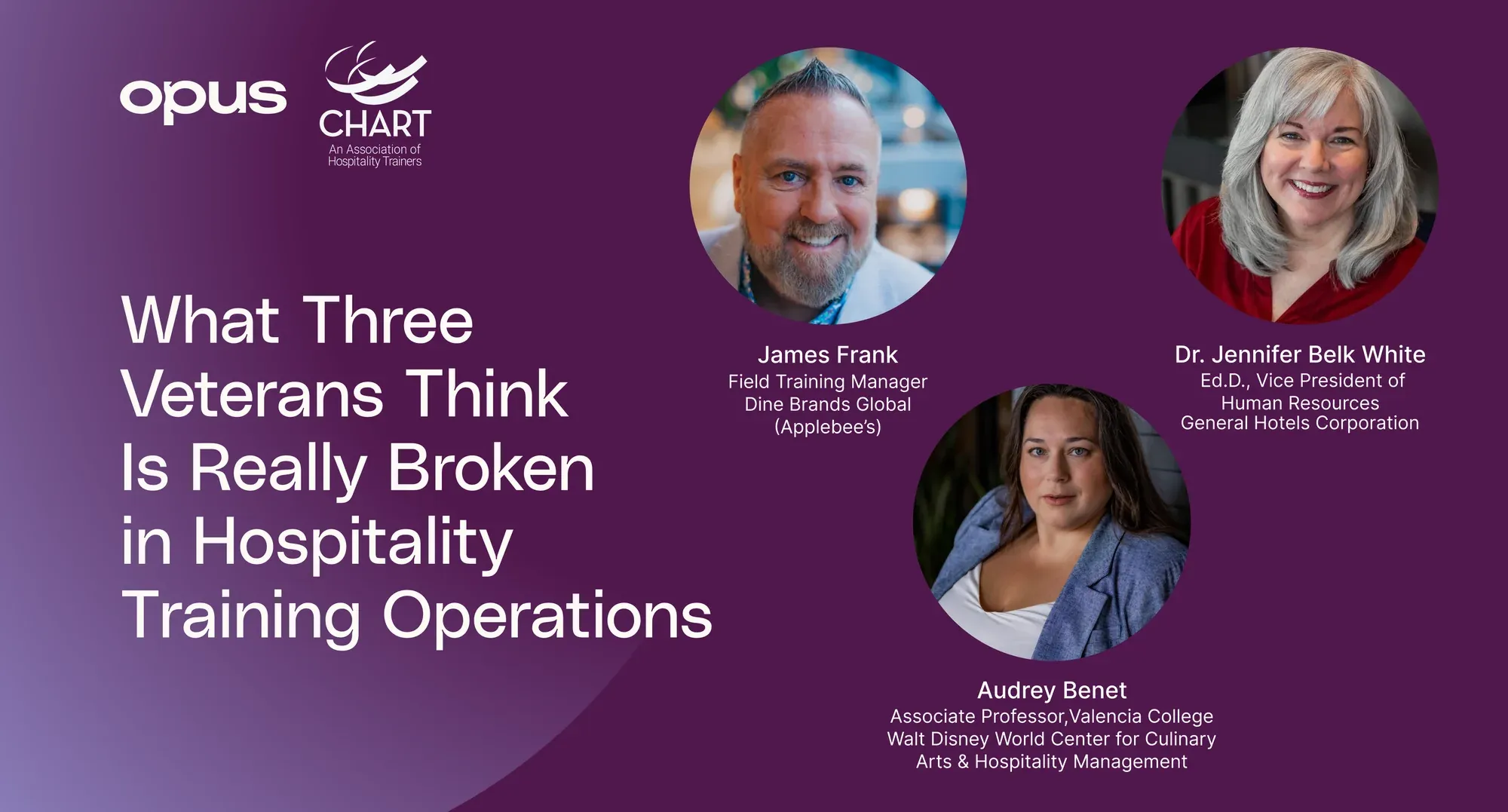
Earlier this month, we brought together three L&D practitioners with a combined 60+ years of experience in hospitality training operations. The conversation, held as part of our annual Hospitality Training 360 discussion, went places we didn't expect. Not because the problems were surprising. Because of how clearly they could name them.
Here's what James Frank (Dine Brands Global), Audrey Bennett (Valencia College, Walt Disney World Center for Culinary Arts & Hospitality), and Jennifer Balk-White (General Hotels Corporation) said that's worth giving major consideration.
💡 This discussion was part of the 2026 Hospitality Training 360 series, hosted by Opus Training in partnership with CHART.
Want the full data behind this conversation? Download the 2026 Hospitality Training 360 Report →
"We moved training to the field. We didn't move the system with it."
James Frank has spent his career in L&D in-field, most recently as Field Training Manager at Dine Brands Global, the parent company of Applebee's, IHOP, and Fuzzy's Taco Shops. He knows what it looks like when training operations aren’t modernized.
"We moved training closer to the field," James said. "But what we didn't do was move the system with it."
That line landed with the group because it's so precise. The intent behind field-led training is right — get development closer to the work, closer to the people doing it. But intent and infrastructure aren't the same thing. When district managers and GMs inherit training accountability without the clarity or tools to own it, you get the same outcome every time: training that happens when it fits the shift and falls by the wayside when it doesn't.
James identified three things field leaders need that most programs don’t factor in:
- What am I actually accountable for?
- What does "good" look like in my specific market?
- How will I know it's working?
Without those three things, even a well-designed program becomes optional under pressure. And pressure in hospitality is not an occasional condition, it's the baseline.
Jennifer Balk-White, VP of Human Resources at General Hotels Corporation and a 33-year industry veteran, pushed this further. The solution isn't a better rollout deck. It's co-design.
"Operators know how to shift gears to operate," Jennifer said. "We need to help them learn how to shift those gears to also train."
Someone in the chat put it simply: "How do you meet store teams where they are without lowering the bar?" It's the right question,and most training programs don't have a clear answer. The ones that do have made a deliberate distinction between what has to be consistent across every location and what can be adapted locally. Standards aren't the enemy of flexibility. Lack of clarity is.
Training vs. Enablement: Why Word Choice Is Critical to Success
During the discussion, an attendee shared something in the chat that James picked up on immediately: "Training is black and white. Enablement is color."
"Training teaches the what," James said. "Enablement supports the how, why, and when."
It might sound like semantics, but it’s bigger than that.
A manager focused on training asks: "Did you finish the module?"
A manager focused on enablement asks: "What part of this feels hardest to apply on a busy Friday night? What gets in the way?"
Those are different conversations. They produce different outcomes. And the language you use at the leadership level determines which conversation your managers are having on the floor.
Jennifer connected this to something she's seen play out over her three decades in hospitality. The best training leaders aren't the ones with the most sophisticated content libraries. They're the ones who've built systems where field leaders feel equipped and empowered to develop their teams in real time.
The caveat James was careful to add: the language shift only works if the expectations shift with it. Calling something "enablement" without changing what you measure, what you reinforce, and what you ask of leaders just produces training with a new label.
If You Can't Connect Training Business Outcomes, You'll Lose the Budget Conversation
Audrey Bennett teaches at Valencia College and spent 25 years in hospitality before moving into education. She came to the discussion with something most L&D leaders don't have: revenue proof.
She walked through what happened when she reframed a leadership ask — a planned vendor-led wine roadshow — around measurable business impact instead of training activity. The team committed to tracking sales before, during, and after. The results held up:
• Wine training produced a $1,000 sustained revenue lift, maintained for 6 to 8 months
• Rum training drove an $18,000 per month increase, sustained over half a year
• Zero-proof cocktails, previously a near-zero revenue category, became a consistent performer within months of targeted training.
The numbers are compelling, but Audrey's point wasn't about the numbers specifically. It was about the method. You define the business outcome first. You design the training to move that outcome. You measure before, during, and after. Then you do it again with a different category and watch the results compound.
"When you lead with the business problem," she said, "leaders lean in."
James echoed this from the field side. The conversations that get traction aren't "complete this module by Friday." Rather it’s, "We're seeing inconsistency during peak hours that's hitting guest experience and sales. This is designed to help you coach those specific behaviors on a busy night."
One framing is a task. The other is a shared problem. Field leaders respond to shared problems.
Audrey's harder point is that L&D has long measured what's easy to pull instead of what leadership actually cares about. Completion data is accessible. Guest experience scores and sales lift require relationships with ops and finance that most training teams haven't built yet.
The fix isn't a new dashboard. It's those relationships, and the time to build them is before the program launches, not after you need to defend it.
READ: Make friends with your ops team
AI Works Best When Humans Are Still Running the Show
Every operator should be using AI right now, no formal rollout required. The teams getting the most out of it aren't waiting for perfect conditions. They're using it today to handle the administrative weight of training operations: drafting content faster, analyzing completion patterns, iterating on programs that would have taken weeks to update manually.
That capacity gets to go somewhere. The best training leaders are putting it back into the field.
James described it plainly: the teams winning with AI aren't using it as a content shortcut. They're using it to free up the time that was previously eaten by logistics, so their people can do more of what actually drives hospitality. The real conversations. The coaching moments. The human interactions that no platform replicates and no guest forgets.
That's the point Audrey and Jennifer kept returning to as well. AI handles the mechanical. The human still governs the outcome.
The Thread Running Through All of It
James, Audrey, and Jennifer were speaking to different parts of the same challenge facing hospitality training operations today.
Training that lives in the field only works if field leaders have the clarity and permission to own it. That clarity only comes when we stop treating training as a task and start treating it as ongoing enablement. And the only way to protect that investment — to keep leadership engaged, to earn the budget and the trust — is to connect it to the numbers they already care about.
Get all three right, and the whole system starts to pull in the same direction.
Opus hosts monthly Office Hours open to training leaders across the industry, not just Opus customers. Join us →