This piece is part of a series drawing on findings from the 2026 Hospitality Training 360 Report, produced by CHART and Opus. [Download the full report here]
The hospitality industry has always trained through people. A GM shows a new hire the ropes. A district manager coaches a struggling shift lead. A regional trainer runs a calibration. Standards travel person to person, shift by shift. What's changed heading into 2026 is who's formally accountable for that work and how much of the L&D function is now expected to run through people whose primary job is operations.
The pressure behind the shift is real. Centralized L&D teams are stretched thin, time is the top constraint across the industry, and the people closest to daily operations are better positioned to reinforce standards in real time than a team sitting two levels removed from the floor. Respondents across the 2026 survey cited plans to move training responsibility to district managers, area team leaders, and general managers. The instinct is sound. What the data also shows is that the shift is happening faster than the support structures around it.
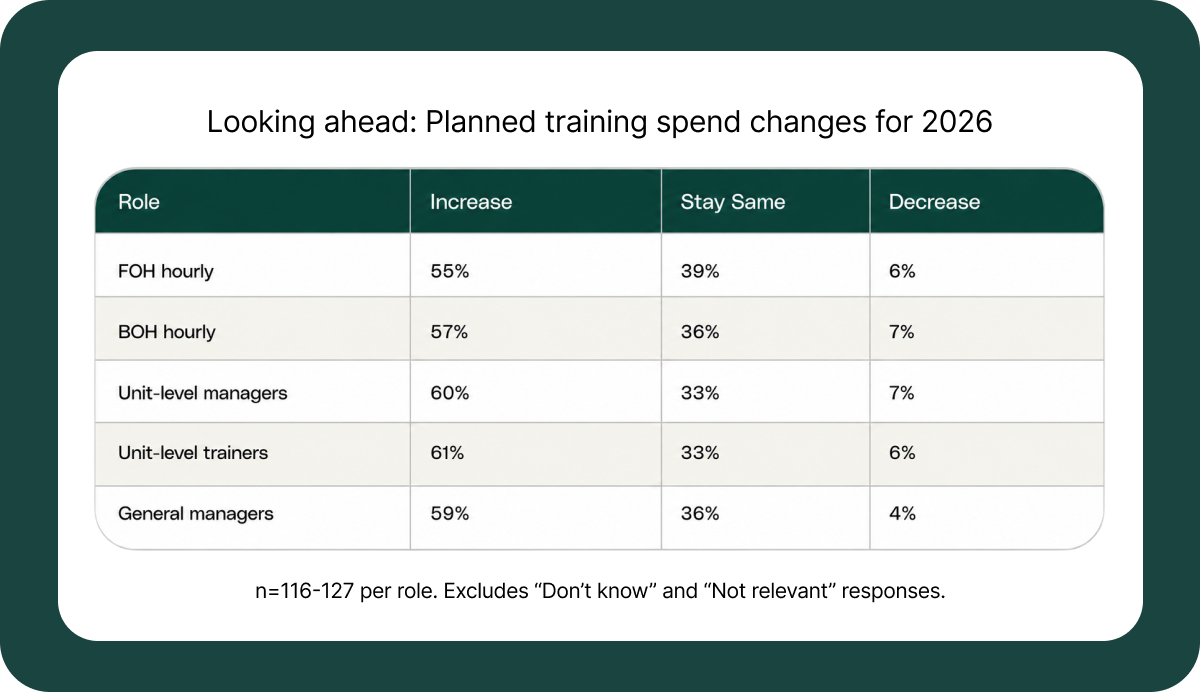
Multi-unit managers saw the lowest budget increase of any group in 2025 - 41%, compared to 50–55% for hourly roles. That gap matters because it reveals the assumption underneath most delegation models: that managers can absorb more training responsibility without materially more support. In practice, that means a district manager is expected to onboard a new GM, run coaching conversations, and maintain training standards across multiple locations while receiving less investment in the tools, materials, and capacity to do that work than the hourly roles they're responsible for developing. The responsibility moved. The resources to carry it didn't.
What field leaders are actually dealing with.
Picture a district manager responsible for five locations. They're troubleshooting a staffing gap at one, fielding a compliance question at another, and trying to find two hours to run a training session for a GM who started three weeks ago. The training is important. So is everything else competing for the same afternoon.
This is the context the 2026 data is describing. Three-quarters of field trainers named a significant execution tension last year. The most common: balancing program improvement against keeping operations running, cited by 42%. A third were caught between maintaining consistency across locations and adapting to what each location actually needs. These aren't planning challenges. They're live, daily trade-offs made under time pressure, with no clean answer.
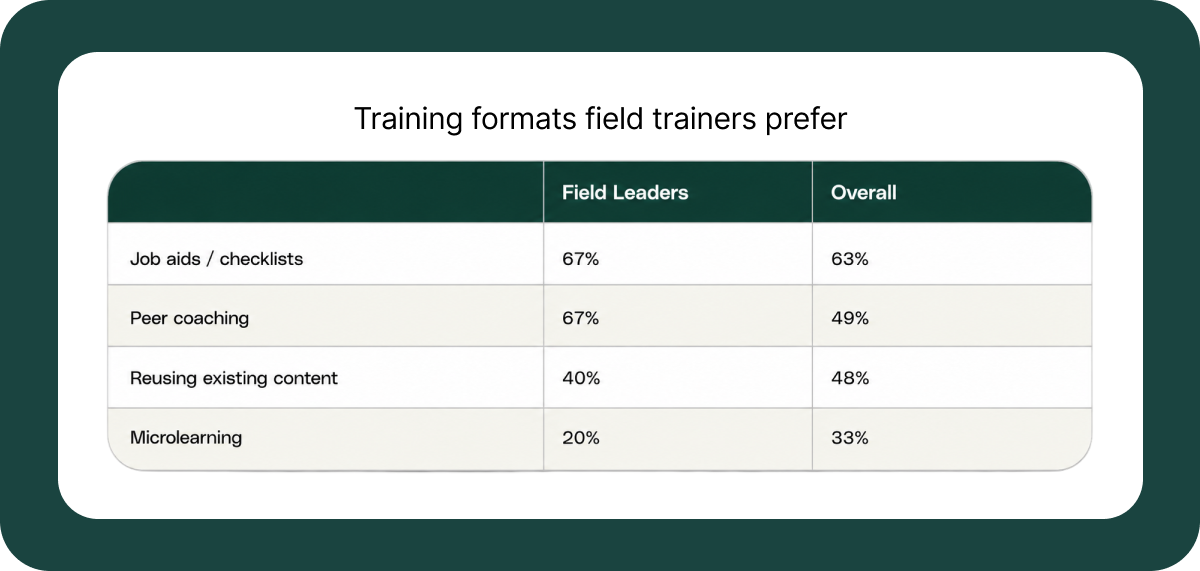
The format data reflects exactly that. Field leaders lean on peer coaching - 67%, compared to 49% overall - because it happens on the floor without pulling anyone off it. Job aids and checklists at the same rate, for the same reason. Microlearning, which requires a device and uninterrupted attention, sits at 20% for field leaders versus 33% overall. The formats that survive are the ones that fit inside a shift. The ones that don't fit get dropped - not because field leaders don't value them, but because something else always needs attention first.
Delegation without enablement just relocates the problem.
When training ownership moves to managers without a corresponding support structure, central L&D has fewer deliverables on its plate. The field leader has more - without the materials, frameworks, or time to execute them well. Quality becomes inconsistent because execution depends on whoever is most capable - or most available - in a given district. The program that looked coherent at the center fragments at the edges.
The 2026 report frames it like this: delegation works when it's part of a system - clear goals, defined ownership, enablement, and verification. Remove any one of those, and the model starts to break down.
💡What it looks like when it actually works.
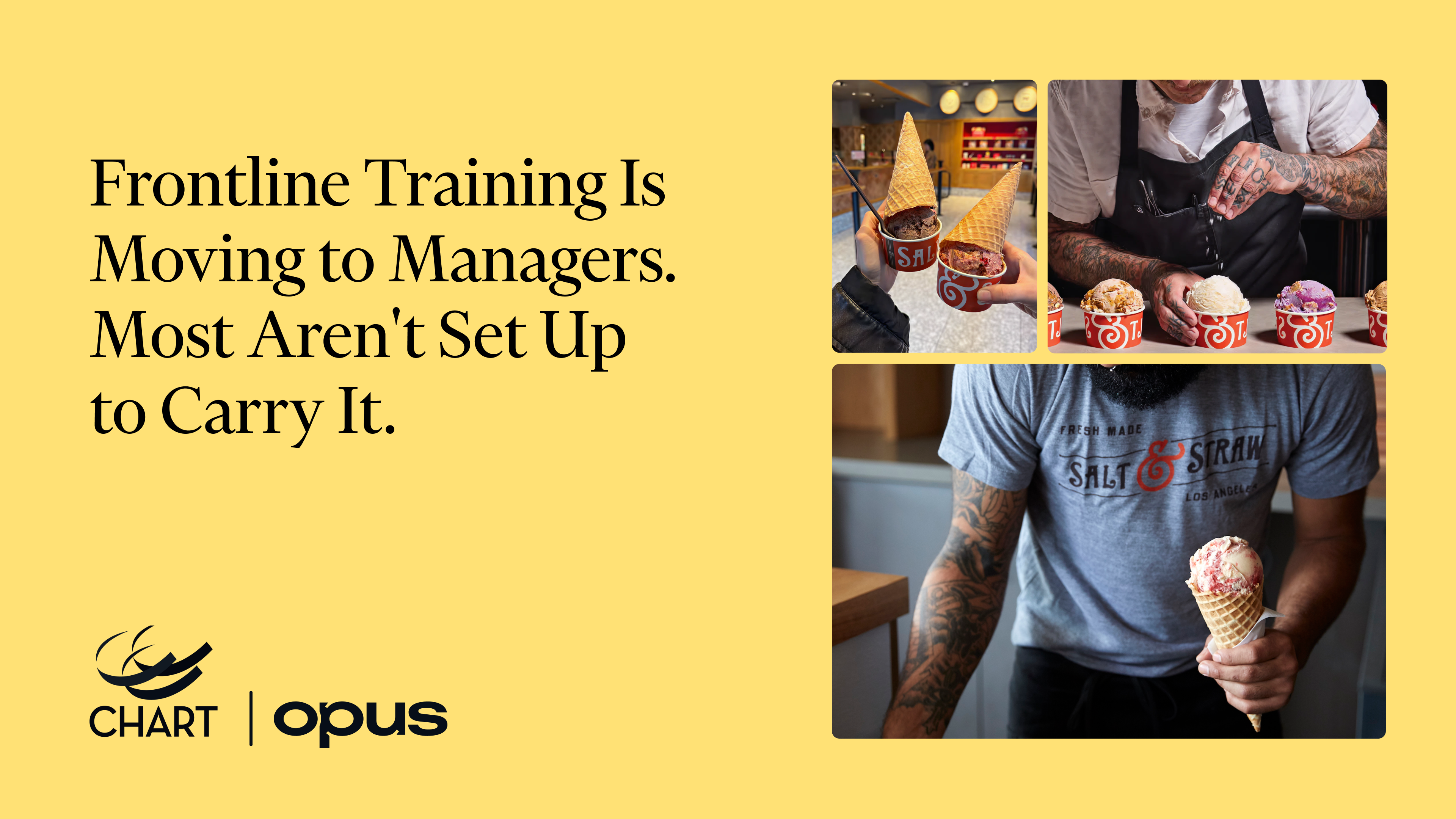
Salt & Straw is an artisan ice cream brand known for seasonal, chef-driven flavors and a strong hospitality culture. As the company scaled past 50 locations, the centralized model for GM onboarding stopped keeping pace with growth. Angela Gintz, Director of Talent and Development, describes the shift to district manager ownership as straightforward in concept but dependent on one critical addition: the accountability architecture that makes it real.
DMs didn't just receive a new responsibility. They received a position-specific performance model that defined what a high-performing GM looks like - not by instinct or relationship, but by metrics and cultural competencies mapped to a grid. The DM became accountable for onboarding, coaching, performance conversations, and metric achievement. Not just "did they complete the training," but "are they performing?"
Gintz described the result: "Once the manager owns onboarding and the performance conversations, they can actually educate to the metrics - and the loop closes."
Critically, Salt & Straw didn't decentralize everything. Brand and culture immersion stayed centralized - a shorter, focused program that protects consistency across markets. Market-level execution moved to districts. The principle: centralize what must be consistent, decentralize what must be fast and local. That distinction is what kept the model from fragmenting.
What delegation actually requires.
The move toward manager-led training is the right direction. It scales better than centralized delivery, keeps reinforcement closer to the work, and builds management capability in the process. What Salt & Straw demonstrates is that the shift works when four things travel with it.
- Clear accountability - not "managers train now," but a defined model that specifies who owns what, how performance is verified, and what good looks like, as Salt & Straw built into their DM performance grid.
- Tools designed for the field context, not repurposed from centralized programs - the job aids and coaching frameworks that fit inside a shift rather than pulling people out of one.
- A calibration process that keeps the people delivering training and the people validating it aligned.
- A feedback loop back to central L&D when something isn't working in the market, so the system can correct before inconsistency compounds.
Most organizations are doing one or two of those. The ones getting results from manager-led training are doing all four.
This post draws on data from the 2026 Hospitality Training 360 Report, produced by CHART and Opus. [Download the full report here]

.jpeg)