Completion Isn't Culture: How bartaco Got Frontline Managers to Own Training
Quick question for you: who's actually responsible for frontline training completion at your org? Now the harder question. Do they know it?
We asked our July Office Hours crowd the same set. The first answer came fast: store managers, DMs, certified trainers, GMs. The second one got quieter. A lot of us assume ownership is obvious. It usually isn't, until someone actually says it out loud.
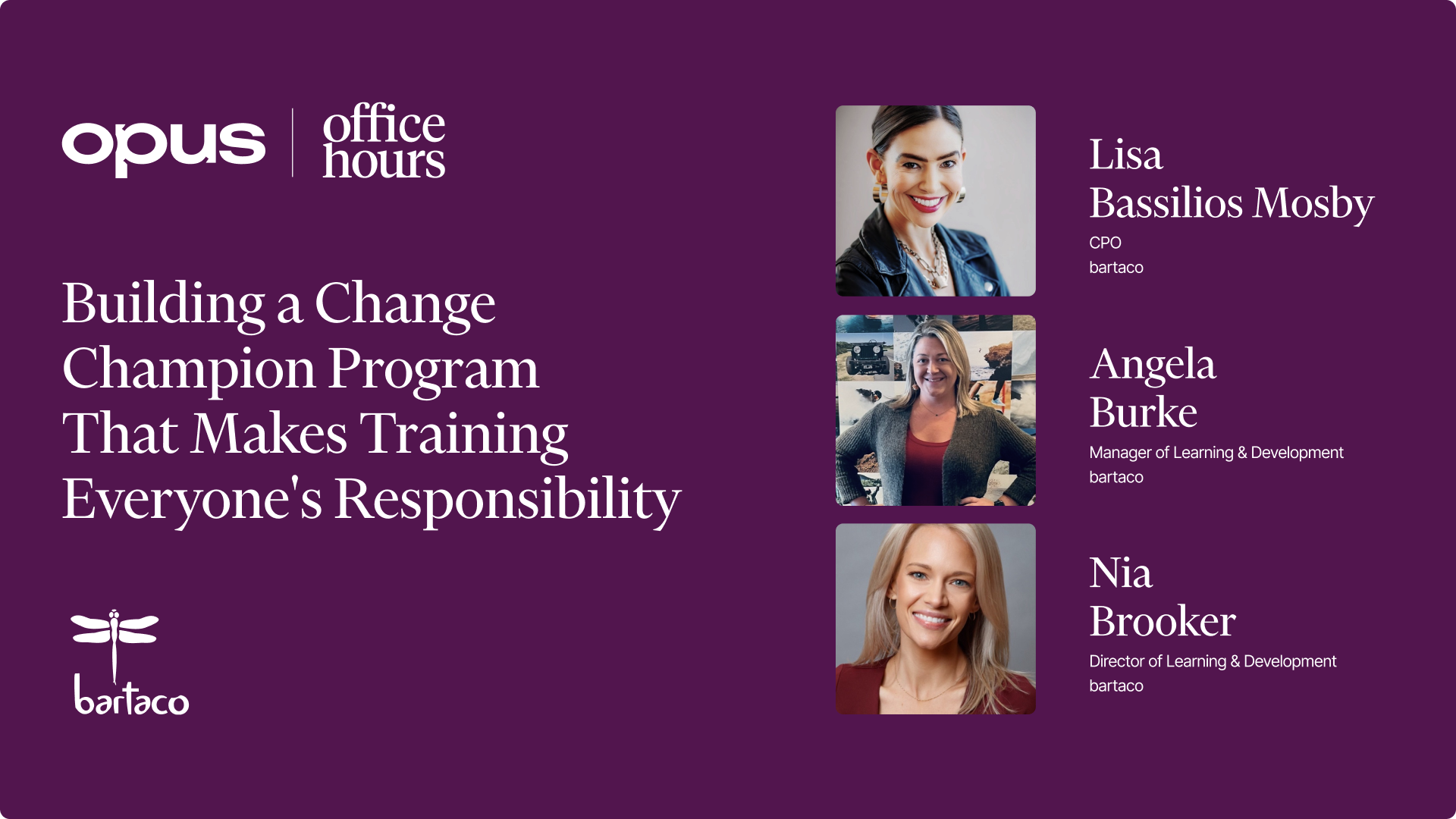
That's the exact problem bartaco set out to fix. We were joined by Lisa Bassilios Mosby, Chief People Officer, Angela Burke, Manager of Learning and Development and a former bartaco general manager in Philadelphia, and Nia Brooker, Director of Learning and Development. They walked us through how they turned training completion from a vague expectation into a real job: Change Champion.
What a Change Champion Actually Is
At bartaco, change champion isn't a new title with a pay bump. It's an existing employee who becomes the in-restaurant ambassador for a rollout. In this case, bartaco's migration from their existing LMS to Opus.
"People trust their management and trust their managers to know what they need and when they need it," Lisa said. Hearing it from your manager instead of a corporate blast just hits different. As she put it, "it holds a lot more weight."
Bartaco treats the role as a growth opportunity instead of a line item. Champions build project management and communication skills, get a direct line to the L&D team through monthly calls, and often have their sights on a future L&D or ops role. Right now the program is limited to salaried managers, but Lisa was clear that an hourly key shift leader with the right interest wouldn't be turned away, it would just mean rethinking pay structure.
They Let the Stores Pick Their Own Champion
Here's the part that surprised even Nia: bartaco didn't hand-pick champions from the top. They told each location what the role required and let the team choose who filled it.
"I thought it would be all the AGMs or training managers," Nia said. "It was a mixed bag. GMs, brand-new managers. People own it more when it's their choice instead of something we push down to them."
Regional directors were looped in before any store heard about the program, giving them a chance to flag concerns L&D might not see from a desk. And when a role didn't carry built-in authority, the bartaco team said they leaned on influence over title, noting flatly that "titles are cheap." The best champions were people who could move a room, whether or not they had the highest badge in the building.
Launch Day: Repetition Over a Single Big Announcement
Bartaco was migrating off a system people already liked, so the team expected resistance and led with why Opus was different, not just that it was new.
Getting the message to land took more than one channel. Angela's team pushed reminders through 7shifts and email early on, telling people to go check Opus, until checking Opus became the habit instead of checking email. They also stood up a GroupMe for champions specifically, because, as Angela said, "everybody's on their phone." A text-style notification cut through in a way email never did.
Contests That Rewarded the Right Behavior
Instead of announcing every contest up front, Angela ran surprise spot checks: if a champion hit a task, she'd send a quick text or call, drop a $100 gift card in their inbox, and let word spread on its own. "L&D just sent me a gift card for doing Opus" became its own kind of momentum.
For Cinco de Mayo, bartaco's busiest season, they did announce a raffle with real prizes: mini projectors, Yetis, JBL speakers. Nothing complicated. Just gear people actually wanted.
What Didn't Work the First Time
Angela and Nia were candid about early missteps. They assigned champions tasks and a timeline, and almost nobody hit it. The fix was getting champions comfortable with the platform first, including how to pull their own completion reports, before asking them to drive their teams.
Nia's other key learning: leaning too hard on new hire training as the first use case. "If you're a five-year team member, what's my reason to go in there?" Bartaco solved this by layering in pre-shift notes, monthly newsletters, and team communications inside Opus, giving every employee, not just new hires, a reason to open the app.
What Happens Once the Launch Buzz Wears Off
The launch momentum always fades. Keeping accountability going week to week takes a steady content roadmap, not one big push. Bartaco keeps dropping new reasons to open the app: a new back-of-house training program, culture moments like a companywide wellness day, and recognition content, so Opus doesn't read as compliance-only.
Separately, bartaco has a standing rule for champion turnover: when someone leaves the role, you replace them right away. They don't leave the seat empty. A new champion gets named, brought up to speed, and folded back into the monthly champion calls without missing a beat.
For coaching champions week to week, Nia and Angela take different approaches depending on where someone's stuck. Struggling champions get direct coaching on why holding a team accountable is part of helping them, not punishing them. Thriving champions get asked to share their approach on group calls, because peer advice from someone doing the job every day lands harder than the same advice from L&D.
Starting a Champion Program From Scratch
Lisa's advice for anyone building this from zero: treat it like a change management project, not a communications task. She pointed to Kotter's Eight Steps to Change as a practical playbook, starting with urgency. One version of that urgency, a line their Opus partner had shared from Shake Shack's CEO: what does it cost you when someone wears your logo without being properly trained?
Your Action Challenge
Identify one potential change champion per location before next month. Then check whether that person's current role already carries enough standing authority to make the responsibility stick, or whether you'll need to build that authority in.
Ready to rollout a new program or training at your organization? We created an easy to customize communications template built off of bartaco's best practices.
Want more sessions like this one? Office Hours runs monthly, with a mix of customer stories, live problem solving, and open Q&A. Save your seat for the next session.
.jpeg)