Most operators know they need a Train the Trainer program. Yet few have one that actually survives turnover, scales across locations, and produces consistent team members long term. That breakdown isn’t typically a lack of effort, it’s a need for structure.
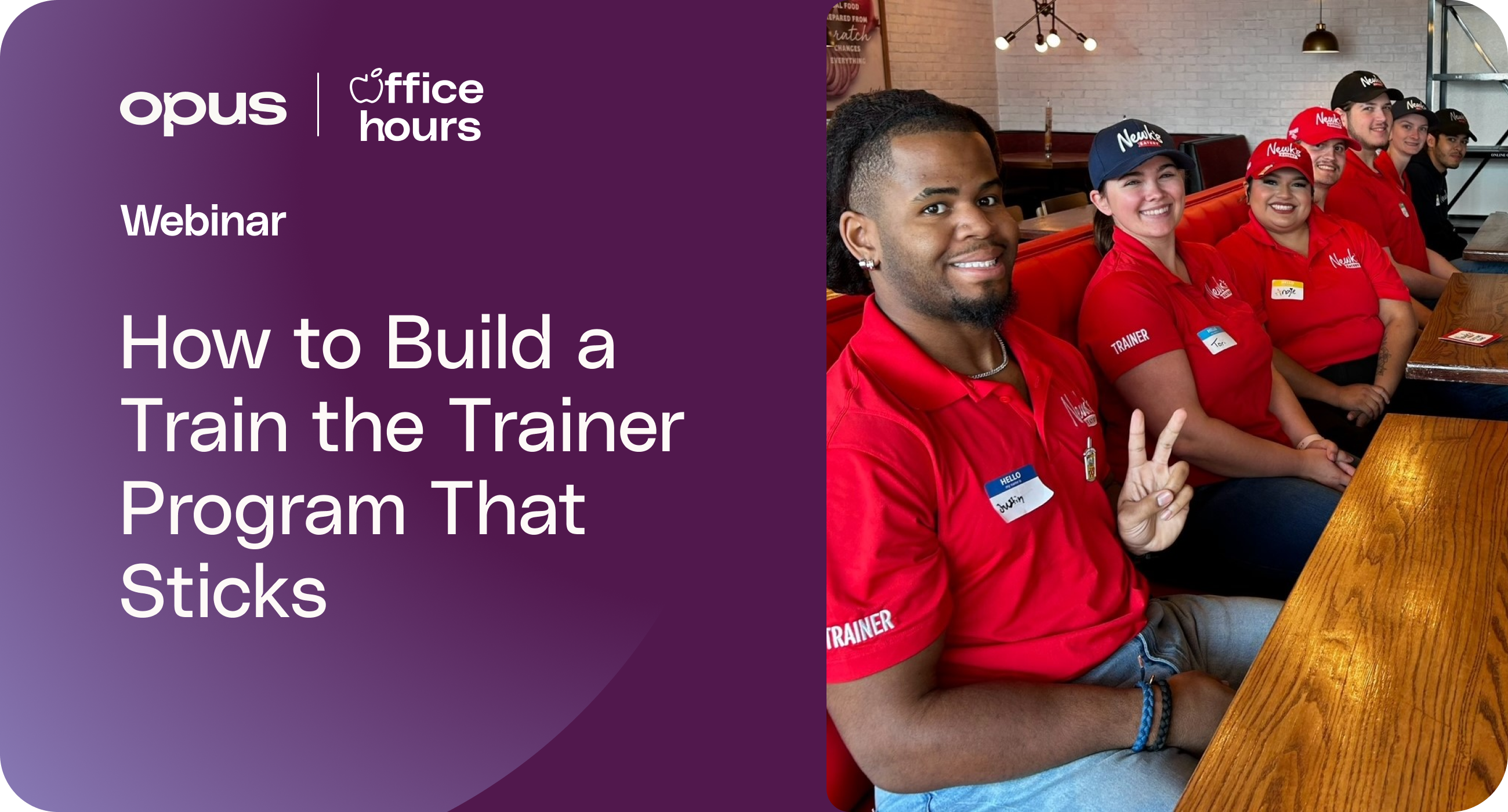
At April's Opus Office Hours, Jessica Drahem, Director of Learning Development and Culture at Newk’s Eatery, walked through exactly how her team built a certified trainer system from the ground up — one that now runs 300+ certified trainers across franchise locations, ties directly to restaurant evaluation scores, and creates pathways for frontline workers to actually grow their careers within the organization.
This is what that looks like in practice.
Start With Your Definition of an A-Player
Jessica's Train the Trainer program begins at the interview. And her criteria for a great trainer aren't what most operators expect.
It's not the loudest person in the room. Not the fastest on the line. When evaluating new hires for eventual trainer potential, Jessica screens for what she calls a "forward lean" : enthusiasm, warmth, patience, memory for procedure, coachability.
"You can teach someone to make a sandwich. You can't teach someone to care."
- Jessica Drahem, Director of Learning Development and Culture at Newk’s Eatery
The cost of getting this wrong compounds fast. Industry estimates put a bad hire at around $5,000 per person when you factor in onboarding, training time, lost productivity, and eventual turnover. But as Jessica put it, the hidden cost is what happens to the people around them: "You struggle to train them, eventually lose them, and maybe lose 1 or 2 really good employees along the way. And then you start over."
She also holds firm on interview standards. She won't bring in a candidate who shows up in flip flops. Whatever your equivalent signal of misalignment is, set the bar, communicate it professionally, and hold it. The people who are serious will respect it.
Putting this into practice
Before you refine your training program, examine your hiring criteria. The soft skills that make a great trainer like patience, coachability, attention to detail, will be an uphill battle to instill after the face.
Tell People Where They're Going on Day One
A piece of advice from Jessisca that might feel a bit counterintuitive: tell candidates at the interview that you want them to eventually take your job.
At Newk’s, managers lay out the full progression upfront: Salad trainer to shift lead to associate manager. They make clear that the company will invest in getting the right people there. This isn't just motivational framing. It changes who applies and who stays.
"People want to feel valued. They want you to see the worth in themselves. If you can present the path at the very start, you've got them committed to more than just the job they walked in for."
This ties back to a theme we explored in March’s Office Hours: How to build front of house service training that changes behavior. Training that sticks isn't just about knowledge transfer, it's about giving team members opportunities to apply what they've learned. When people see a path, they invest in getting good at their current role. They’re able to see that it's the stepping stone along their career path.
Start Small…Like One Station Small
For operators feeling the weight of building a program from scratch, Jessica's advice is simple: start with one station: your strongest one.
At Newk's, that was the salad line. Not because it's the most complex, but because that's where their best people were. Find your strongest person on that station. Get them certified. Build one training around what they already know how to do. Release it, observe what happens, then move to the next station.
"I would encourage you to pick the easiest section of your business, write a small guide for it, and build the Opus module for that."
Newk's didn't launch their full training library in a single push. They started with salad. Now they have station guides, certified trainer modules, reference materials, and cross-training paths for every line. A program that reaches 300–500 certified trainers was built one station at a time.
Don't wait for a complete library before you start. One module, paired with a paper checklist trainers can hold during the shift, is a functioning program. You can build from there.
Make Certification Mean Something
Earning “Certified Trainer” status at Newk’s requires demonstrating real readiness. Before someone can train on a station, they must:
- Be certified on that station themselves
- Complete 3 opens and 2 closes on that station
- Reach 100% completion in Opus
- Receive manager sign-off on observed performance
- Demonstrate the Tell, Show, Do, Review method
- Train a new hire while being observed by the General Manager
That's a meaningful bar, and it's intentional. When certification is rigorous, the badge means something. At Newk's that's literal: a certified trainer pin, a red polo, a 100% completion pin for the hat. Small but visible things that employees who have earned them wear with pride.
After certification, new trainers aren't immediately cut loose. For their first 2–3 shifts with a new hire, they're observed by a people manager or senior certified trainer, which mirrors exactly what they're expected to do for their own trainees.
That sends a powerful message: we invest in the people who invest in others.
Spec Is Spec Is Spec - And Your Platform Has to Back It Up
One of the most common points of failure in mature training programs isn't at launch. It's six months in, when experienced team members start filling the gaps between what the manual says and what "everyone actually does."
Jessica's response is consistent: go back to spec. Refer to the Opus reference section. Pull up the station guide. Challenge me if you think I'm wrong, but spec is spec.
Newk’s open kitchen concept helps create a culture where this kind of checking is natural. When a manager misstates a spec, a team member might say, "I believe that comes with mayonnaise, but let's check." That's celebrated, not corrected. It's how accuracy stays intact at scale.
But this only works because the materials are trusted. Station guides live in both paper (on the station) and digital (in Opus). They're reviewed annually, updated on a two-cycle-per-year menu cadence, April and October, plus real-time LTO swaps.
"Keeping your training material relevant is the most important element others overlook. You can't just develop it and go on about your merry way."
When training materials fall out of date, trainers stop referencing them because they know they're wrong. The guide becomes shelfware. Every trainer starts freelancing. Maintaining content isn't a back-office task, it’s a core function of training integrity.
The ROI You Can Measure, and the One You Can't
Newk’s ties Opus completion rates directly to restaurant evaluation scores and cross-references customer feedback (via Ovation) against training completion data. Franchise owners can see a store's completion rate as a performance metric. That's the visible ROI.
But the more compelling evidence is harder to put in a dashboard.
Jessica closed the session with Rihanna's story: a prep employee who cross-trained through the full pathway: salad, pizza, sandwich, expo, certified trainer, shift lead, associate manager. When her husband relocated to Florida, her Newk’s credentials traveled with her. She secured an associate manager role there. Three months ago, she joined Jessica in the corporate training department.
"She's a hard worker. She has attention to detail. She's tenacious. We picked her for the job five years ago and didn't even know it."
A Train the Trainer program isn't just a staffing solution. Done well, it's a leadership pipeline that multiplies your impact far beyond any single location.
Key Takeaways
Most Train the Trainer programs fail not because of poor intentions, but because they start at the wrong place, move too fast, or treat certification as a one-time event rather than an ongoing standard.
Newk’s approach works because every element reinforces the same message: this matters, and we're serious about it.
Three places to start this week:
- Audit your current hiring criteria against the soft skills that actually predict trainer success: patience, coachability, attention to detail, warmth.
- Pick the one station or process where your strongest person operates and build or refresh a single training module for it.
- Review your most-referenced training materials. Are they current? If team members wouldn't trust them enough to refer back to them, find out why.
Ready to build a training program that scales? Let's talk →

.jpeg)