
Training Budget Has Come Back. Here's How to Keep It.
This piece is part of a series drawing on findings from the 2026 Hospitality Training 360 Report, produced by CHART and Opus. [Download the full report here]
Heading into 2026, hospitality L&D is in a better position than it's been in recent years. Training budgets increased across every role in the last year, and 55–61% of respondents expect them to grow again this year. Confidence is high - 85% rated their certainty that training positively impacted business outcomes at four or five out of five. AI is doing more of the production work. Teams have more to show for their time.
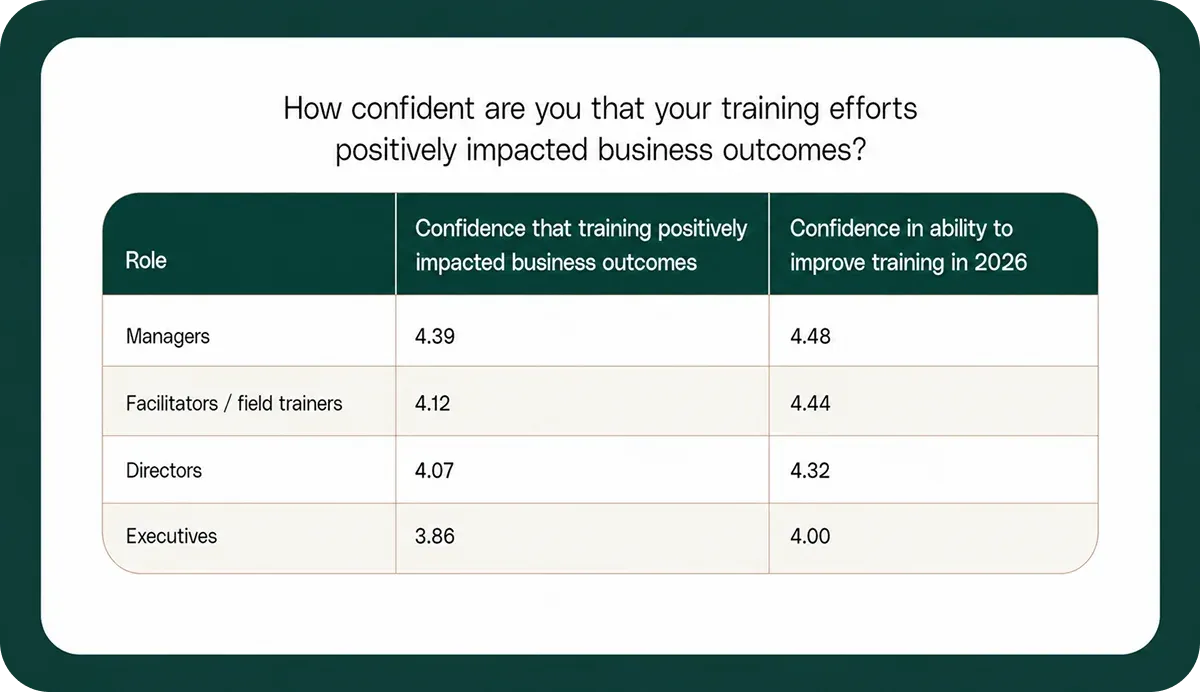
And yet 81% are still measuring whether training works by asking managers how they feel about it.
That number sits at the center of a problem that better budgets won't fix on their own. Manager feedback captures things that don't show up in data. But it's the easiest metric to collect and the hardest to defend when a CFO asks what the training budget actually bought. Most L&D teams know this. Most haven't changed it.
The gap that isn't visible from inside the team.
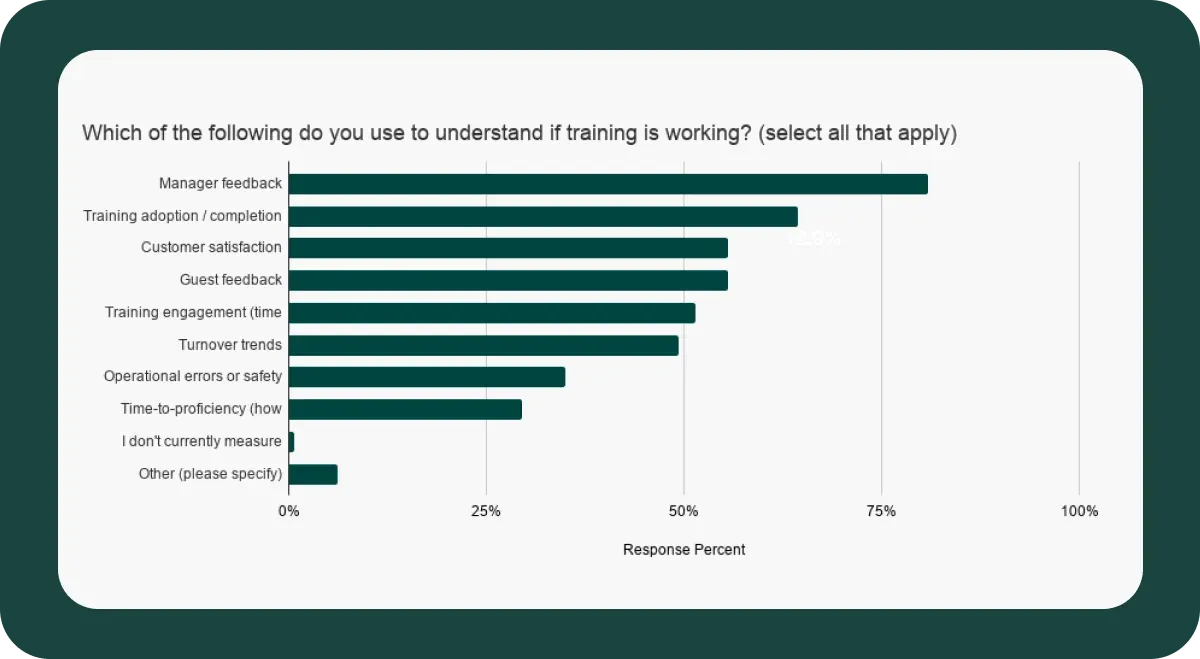
The 2026 data breaks confidence down by role, and the results don't point in the same direction across the org.
Managers rated their confidence that training impacted business outcomes at 4.39 out of 5. Executives rated it 3.86 - the lowest of any role in the survey. The same people who control the budget are the least convinced it's working. They're also the least likely to report significant training challenges, which means they don't feel the urgency their teams do.
That gap exists because both groups are drawing on different sources. Managers see training run. They see the before and after at the team level. Their confidence is real, but it's built on proximity. Executives see the numbers: revenue, turnover, throughput, error rates. They can't draw a line from those numbers back to anything that happened in a training room.
Without something to bridge that gap, there's limited motivation to invest further. Goodwill fills the space for a while. It has a shelf life.
What the data already shows - and most teams still haven't acted on.
Last year's report made a clear connection between measurement and budget: teams that tracked operational metrics were nearly twice as likely to see a budget increase - 55% versus 30% for those relying on training-only metrics. The implication was straightforward. Track something your CFO already cares about, and your case for investment gets considerably stronger.
A year on, most teams haven't made the shift. Time-to-proficiency - how quickly a new hire reaches independent performance - is tracked by only 29% of respondents. Operational errors or safety incidents by just 35%. Meanwhile, 81% still lead with manager feedback, which tells leadership how training felt, not what it moved.
The gap isn't about access to data. Operations and finance already monitor error rates, turnover, and service speed. The problem is that most training programs were never designed with those numbers in mind. When a program doesn't start with a specific metric it's trying to move, there's nothing to measure at the end - and nothing to show when budget season arrives.
Where to start calculating ROI in L&D.
Pick one metric your CFO already watches and build backward from it.
- Turnover in the first 90 days
- Ticket accuracy
- Guest complaint rate
- Speed of service
Choose the one where training has a clear line of influence, then design the program to move it. Track it before and after.
Track time-to-proficiency for your next new hire cohort.
Define what "floor-ready" looks like for the role - not training-complete, but independently performing. Measure how long it takes to get there. That number alone gives you something concrete to improve against and report on, without adding significant work to how the program already runs.
Separate manager feedback from manager observation.
Asking a manager "how's the new hire doing?" is feedback. Asking them to confirm specific observed behaviors against a checklist at 30 and 60 days is data. The latter holds up in a conversation with leadership. It also makes the manager's accountability in training more specific, which is worth something on its own.
Build the infrastructure now.
For most teams, training is working. The 2026 data is clear: training is working, investment is growing, and teams are more capable than they've been in recent years. Most programs however are still missing the ability to demonstrate that to the people who approve the budget, and in terms of the numbers that leadership already tracks.
The teams most likely to keep their budgets growing are the ones building the measurement layer now, while conditions are in their favor. One operational metric tied to training. A time-to-proficiency baseline for your most critical role. A structured observation process that turns manager instinct into documented evidence. None of that requires a new headcount or new technology. It requires deciding, before the next program launches, what it's supposed to move.
This post draws on data from the 2026 Hospitality Training 360 Report, produced by CHART and Opus. [Download the full report here]