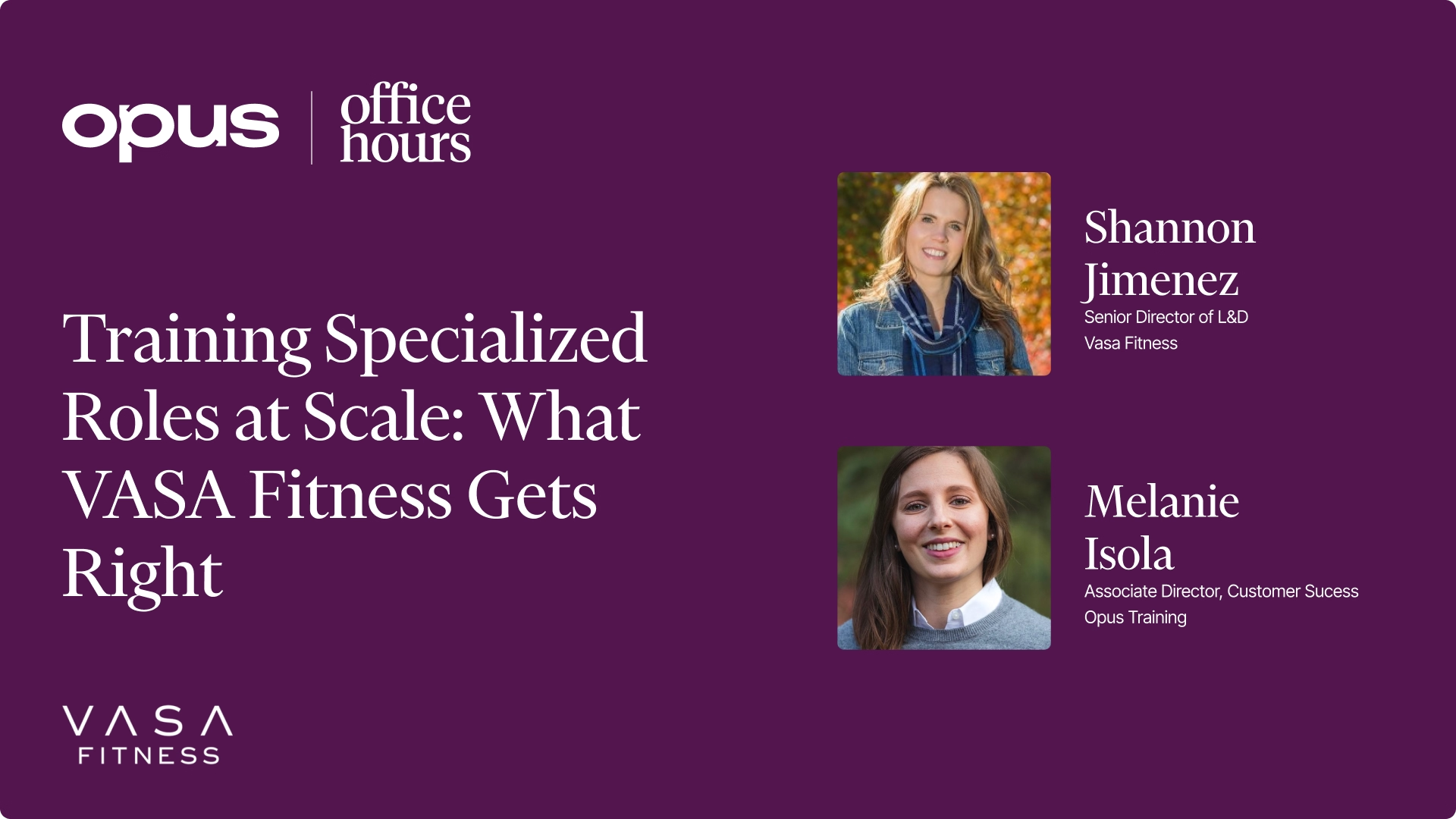
Training Specialized Roles at Scale: What VASA Fitness Gets Right
When you hire someone for a specialized role, a personal trainer, a sommelier, a licensed esthetician, you're not starting from zero. You're working with someone who already has a certification, years of floor experience, and strong opinions about how things should be done. That's a fundamentally different training problem than onboarding a new hire from scratch.
Most training programs aren't built for it. They assume a blank slate. The content is too basic, the pacing too slow, and the whole thing signals to an experienced hire that you don't really see what they bring.
That was the framing for June's Office Hours session, where Shannon Jimenez, Sr. Director of Learning & Development at VASA Fitness, walked us through how her team solves this for personal trainers. Certified professionals with established habits and strong existing opinions. VASA operates 74 locations across Colorado, Utah, Illinois, and the Midwest, fully corporate owned, no franchise model. Their standards live and die by what L&D builds.
The principles she shared apply well beyond fitness.
Start with common ground, not a curriculum
VASA doesn't pretend personal trainers are blank slates. Shannon's team begins by finding the shared why: both the trainer and VASA want to change people's lives through fitness. Once that common ground is established, the training shifts to what success looks like specifically at VASA, anchored to the company's core values.
The goal isn't to undo expertise. It's to redirect it.
This starts earlier than you might think. VASA includes their why in the job description itself, attracting candidates who already align before they ever step onto the floor.
Skip what they already know
VASA's personal trainer onboarding doesn't include anatomy. They assume their hires have that. The program starts at level two: business acumen, consultation standards, the VASA-specific skills that close the gap between a good trainer and a successful one at their gyms.
This is a meaningful design decision. When you train skilled roles, wasting their time with content they've already mastered signals you don't see them clearly. Starting where they actually are builds credibility for everything that follows.
Deficit learning: figure it out, don't just absorb it
Shannon introduced a concept called deficit learning. Rather than delivering information, you put learners in situations where they have to discover it. VASA does this with a club scavenger hunt during onboarding, where trainers go find their kid care partners, their studio coaches, their general managers.
The exercise isn't busywork. It's how trainers learn who helps them build a personal training business.
The question isn't "who is the general manager?" It's "how does partnering with the general manager help you book more consultations?" Trainers figure out the connection themselves, which means they remember it.
Scenario-based learning for people who think they have it figured out
One of the trickier things about training experienced roles is that resistance to feedback. Scenario-based learning sidesteps that. When you give someone a realistic situation and two options that are both technically defensible, you prompt reflection without triggering defensiveness.
VASA builds scenarios with a clear stronger answer and an explanation tied back to the skill. The learner isn't being corrected. They're thinking.
Reflection questions that do more than assess
VASA uses open-ended reflection prompts throughout their modules, but not primarily to measure comprehension. The prompts are designed to acknowledge expertise. Asking a trainer to articulate why their role matters to the member, to the club, and to the business grounds them before the training even begins. It signals: we see what you bring.
Shannon was direct that she doesn't always need a manager to sign off on skill development. VASA trusts their trainers to reflect, record, and self-direct. The self-directed check-in feature in Opus came directly out of that need, built in partnership with Shannon's team and released in 2026.
Peer video builds credibility faster than any curriculum can
Shannon doesn't have a personal training certification. She knows it. Her solution: record trainers who are doing it right and let the content speak. When a learner hears a peer walk through a consultation scenario, the credibility is built in.
For the most part, VASA trainers love being part of the videos. A few ask to stay off camera. For the ones who are in it, seeing themselves in the training reinforces the culture Shannon is trying to build.
It's also the same instinct people follow outside of work. If you want to learn something, you go to YouTube.
We covered a related dynamic in April's session with Newk's Eatery. How peer credibility and certified trainers work together to make training stick.
Don't be afraid to invest in people who might leave
One of the more refreshing things Shannon shared: VASA doesn't let fear of turnover limit how much they invest in their trainers.
Their philosophy is that changing people's lives extends to employees, not just members. If a trainer takes what they learned at VASA and applies it somewhere else, that's a good outcome. The goal is to be part of their journey, and to make VASA compelling enough that they choose to stay.
It's a harder position to hold than it sounds. But it's the one that tends to produce better training.
Start with measuring one thing. You don't need a full ROI study.
Shannon's approach to proving impact is practical. At the start of every project, her team asks two questions: what business problem are we solving, and how will we know if we're successful? That second question sets the baseline.
When VASA launched a new personal training app, the metric was simple: how many consultations are being booked? Baseline before launch. Numbers after. She's not claiming causation — too many levers are being pulled at once — but she can show correlation. And she can show up to a QBR with data.
Pulling those numbers requires working cross-functionally with Finance and Ops. L&D that stays siloed stays reactive. The teams that know what to measure before a program launches are the ones that get to sit in the rooms where decisions get made.
Her format for sharing results: a one-pager. High-priority projects, what was built, what moved. Ready for any meeting she can get on the calendar.
We went deeper on this in May's Office Hours. How to ask the right questions of your data before you ever open a report.
The theme running through all of it: training skilled roles requires a fundamentally different orientation. You're not filling an empty cup. You're working with one that's already full, redirecting what's there toward the standards and culture of your specific business.
Missed this session? Reach out to your CSM for a link to the recording.
Have a topic you'd like us to cover in a future Office Hours? Let your CSM know — we crowdsource our agenda based on what's most meaningful to you.

.jpeg)