Finance has the numbers. Operations has the context. But the two teams rarely talk to each other proactively.
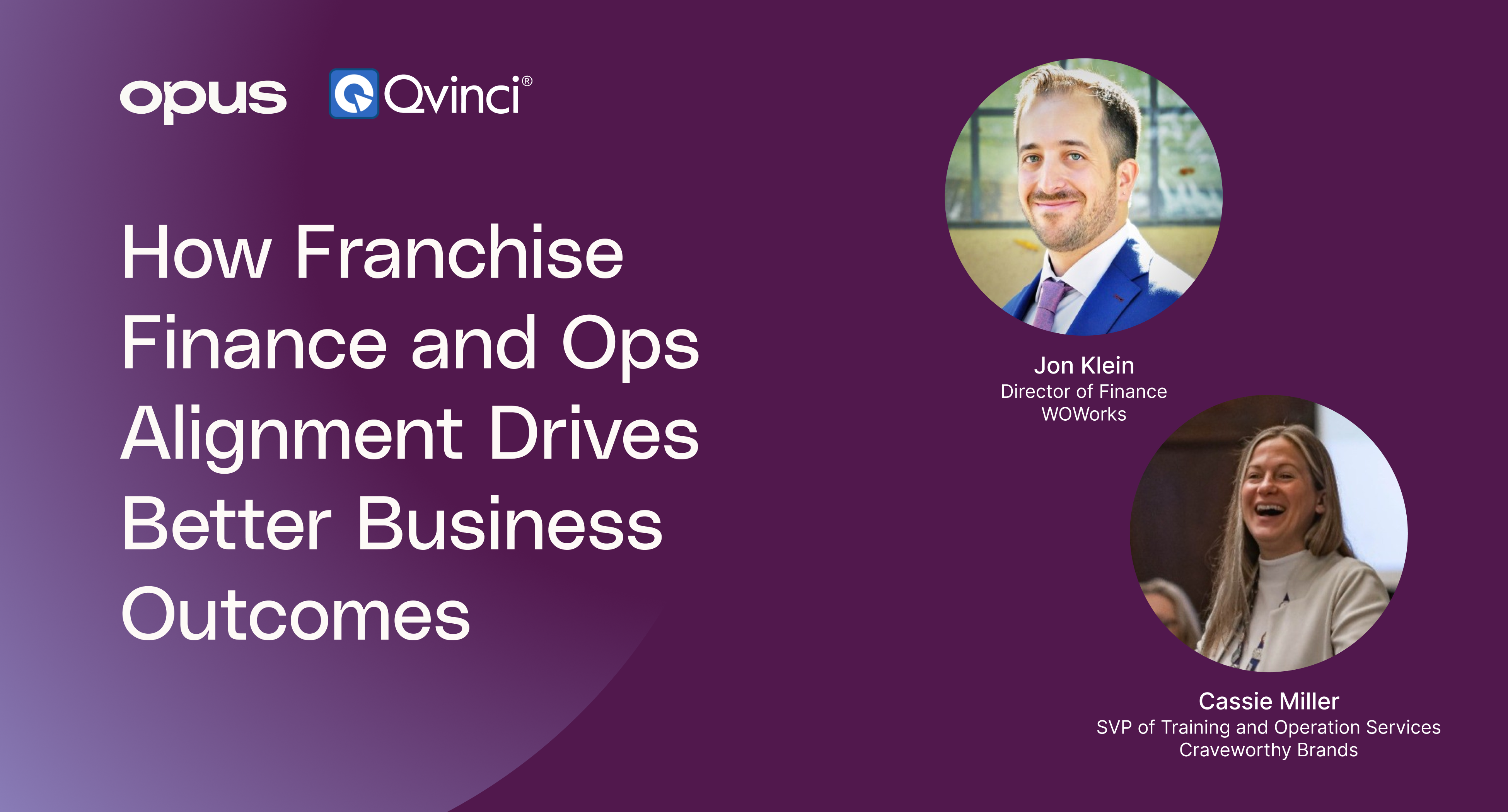
That's the situation Opus and Qvinci set out to unpack in a recent webinar featuring Cassie Miller, SVP of Training and Operation Services at Craveworthy Brands (21 brands, 300+ locations), and Jon Klein, Director of Finance at WOWorks (6 brands, 350+ locations). Here's what they shared.
Why Finance and Ops See Different Problems - Even When Looking at the Same Store
The first thing Cassie and Jon agreed on: finance and ops are actually looking at the same goal. Top-line sales matter, but it's the middle of the P&L where the real levers are.
"You can have fantastic top-line sales, comping year over year. But if you're not bringing that money to the bottom line, there's a gap. We're not managing the middle of the P&L."
- Cassie Miller, SVP of Training and Operation Services, Craveworthy Brands
COGS, payroll, and occupancy - pull the right levers, and the numbers move. Ignore them, and strong sales can mask a serious problem.
The challenge isn't disagreement. It's language and context.
Finance teams see the numbers clearly but often lack the operational context to know what's driving them. Jon's background in operations changes how he reads data - knowing whether a chicken order should come in at 10 pounds or 50 pounds is the difference between catching a bad invoice and letting a cost problem compound across dozens of locations.
Ops leaders, on the other hand, understand the floor but struggle to connect what they're seeing to the P&L. Many are first-time franchise owners, managers promoted from within, or GMs who've never had to read a financial statement. They're running restaurants every day, but the numbers don't mean much yet.Same problem. Both sides just need the other's context to solve it.
The Financial Literacy Problem Is a Training Problem
If there's one thing that consistently trips up operators, it's the P&L prelim. Managers are responsible for reviewing it every period - flagging double invoices, verifying labor lines, making sure the numbers actually reflect what's happening in the store. But a lot of them don't know how to read it, let alone what to do when something looks off.
That's the problem Cassie's team is solving. And they treat it like any other operational skill - not a one-and-done module, but a multi-step process:
- Teaching them how to read the P&L - what each line item means, what to look for
- Connecting it to real behaviors - how to investigate cost of goods, how to read a Sysco invoice, how to look at labor against their sales forecast
- Following up with targeted support - office hours, webinars, peer learning from top-performing GMs
As Cassie said, "We can't dig into how to improve the financials without training them how to read the financials."
How Better Data Changes the Conversation
Before WOWorks consolidated P&L data through Qvinci, Jon's team was piecing together whatever franchisees sent - PDFs, Excel files, different time periods, different formats. Nearly impossible to benchmark or trend-spot.
After the switch, they had three years of consistent, comparable data across 300+ locations. Outliers became obvious. Averages became meaningful. And the conversation with franchisees changed: instead of asking them to manually enter data, the ask became spend 15 minutes, sync your QuickBooks, and you'll stop hearing from us about it.
"The more data you have, the more accurate it is, the more you start seeing better trends."
- Jon Klein, Director of Finance, WOWorks
When the numbers are reliable, franchisees trust them. And when they trust them, they act on them.
The Franchise Business Consultant: The Person Who Actually Bridges the Gap
Both Cassie and Jon kept coming back to the same role: the Franchise Business Consultant (FBC). They're the ones with relationships on both sides, translating financial data into something an operator will actually hear.
From Cassie's side: when her team spots a pattern, they don't push a training solution directly to the franchise. They go through the FBC first, because the FBC knows whether the root cause is actually what the data suggests.
From Jon's side: he uses data to arm FBCs before conversations happen. But there's a balance between "here's a coaching opportunity" and "you're out of compliance" - and finance and ops have to agree upfront on who has which conversation.
When it all comes together, the FBC has the data they need, the training they can point to, and the credibility to help an operator actually change behavior.
Measuring What Actually Moved
The million-dollar question in L&D: how do you prove training worked? Cassie's honest answer: there's no clean formula. But there are better practices.
Start with a North Star. Cassie's is the certified training restaurant - a location that checks every box: positive comp sales, COGS at or below budget, labor at or below budget. It becomes the benchmark for everyone else. Training ROI, at least directionally, is the distance between where you are and where that restaurant is.
Benchmark before you launch. Craveworthy ran an order accuracy campaign - new course in Opus, job aids, fun collateral - and then had to go back and dig up pre-launch scores to compare. "Know the numbers for what you're trying to improve at that moment in time. Benchmark the date you launched, then monitor at 30, 45, 90 days."Jon's approach from the finance side follows the same logic.
Zoom in, then zoom out. Start with the locations you trust - consistent data, reliable history - and see if the trend you're expecting actually shows up. If it does, broaden the lens. If it doesn't, you have a different problem to investigate.
Jon shared a good example: a menu change that was supposed to reduce food costs didn't show up right away because a supply chain disruption offset the savings. Without knowing both factors, someone would have concluded the menu change failed. It didn't - the two events just canceled each other out.
What's Next: AI as a Thought Partner
Both Cassie and Jon see AI playing a bigger role in closing the gap - not as a replacement for judgment, but as a first pass.
Cassie's take: feed financial data into a tool trained to look at it through a training lens. It won't always surface the right priority, but it moves her team faster without requiring a finance person in the room to interpret the numbers.
Jon's take: the real problem isn't tools, it's misaligned goals. Finance and ops are often working toward different objectives. AI that helps both sides see the same picture could make the collaboration easier.
Key Takeaways
- Top-line sales and store-level EBITDA both matter. You need both to understand what's actually happening
- Financial literacy is a training responsibility. If your operators can't read a P&L, they can't improve it
- Consistent, comparable data changes what conversations are even possible between finance and field teams
- FBCs are the bridge. The best finance and training work only lands when there's a trusted relationship in the middle
- Pre/post benchmarking is the minimum for measuring training impact - know your numbers before you launch anything
- AI is coming. The teams already thinking about how to give it the right lens will move faster
Opus is a training operations platform helping multi-unit brands drive consistent operations across their frontline teams. To see how operators like Craveworthy Brands use Opus to connect training to business outcomes, request a demo.
Prefer to listen? The audio version is available here.
.jpeg)