If you're running training for a multi-concept company, you already know the problem. You can't run one playbook across a dozen hotel brands, four restaurant concepts, a landscaping crew, and a retail center. Standardize too much and you lose what makes each concept work. Leave too much up to individual locations and nothing's consistent.
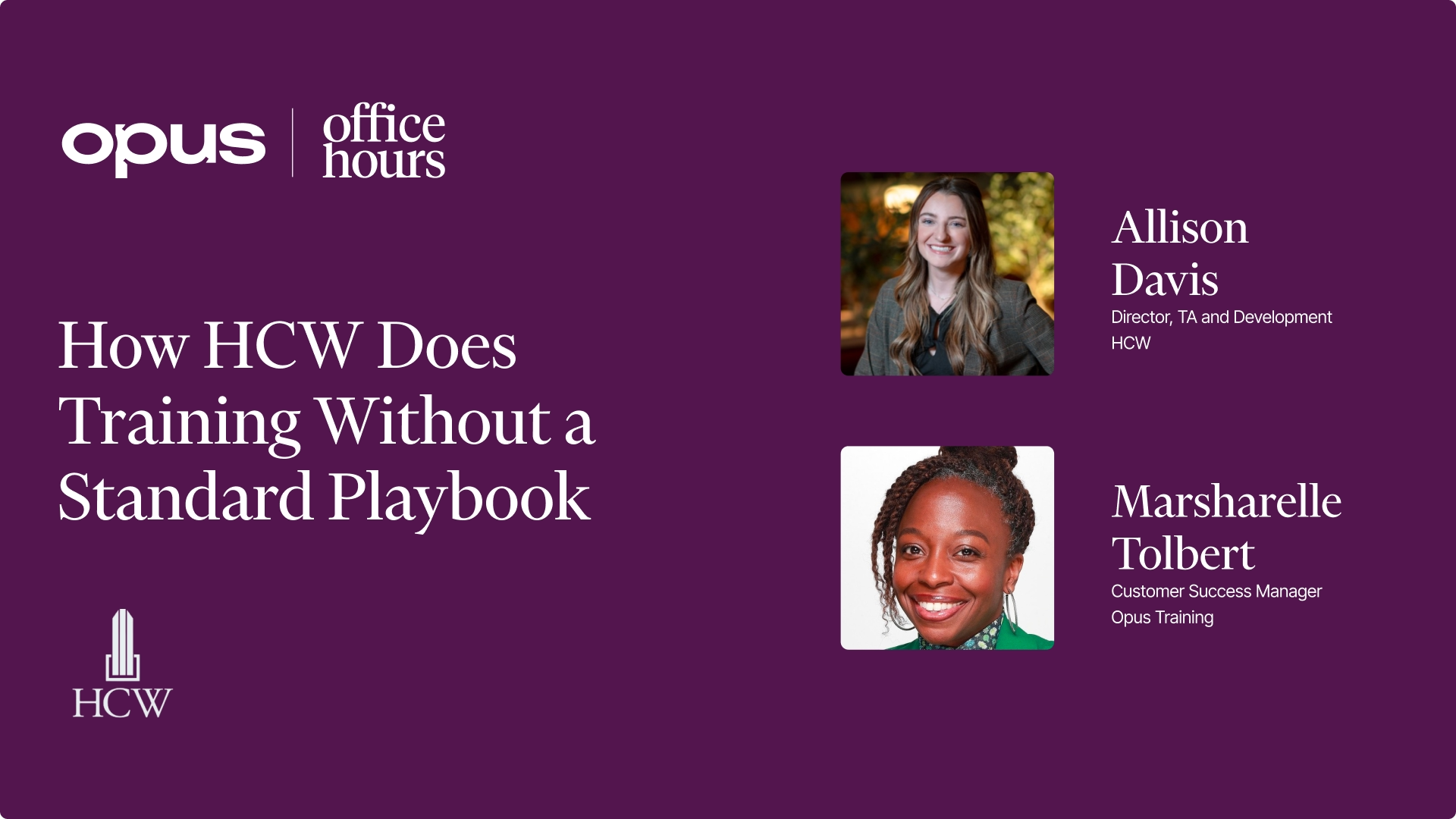
That's the exact spot Allison Davis was in three years ago at HCW. HCW started as a real estate development company thirty years ago, and only took over managing its own hotels and restaurants about six years back. Allison leads training and talent development on the hospitality side, which today means 12 hotels (franchised through Hilton, Hyatt, and Marriott), four independent restaurant concepts, a landscaping business, a retail shopping center, and a golf course. No shared playbook in sight.
She joined us for two Office Hours sessions to talk through how she built one anyway: starting from nothing, getting every concept and role speaking the same training language, and using AI to score almost a thousand open-ended survey responses a month without losing control of what the data actually says.
Reach comes before role
When Allison started, HCW didn't have anything you'd call a training system. Managers got handed a topic and were on their own to build and deliver it, with no consistency and honestly no way to even confirm it happened.
Her first move wasn't to pick a department and build role-based training. It was to ask what's true for every single team member, no matter the concept or the job. That turned into a monthly module sent to every property: a company newsletter, a service or hospitality training, and whatever safety or compliance course was required that month, all bundled together.
The pitch to managers was blunt: this replaces the in-person training you're already scrambling to pull off, it takes less time, and you don't have to facilitate any of it. Saying that is easy. Proving it is what actually got buy-in, so Allison pulled Opus's time-to-completion data and put a six-to-ten-minute monthly module next to the hour-long all-staff meeting it was replacing.
Full adoption still took about nine months. Instead of pushing every property at once, Allison worked closely with whichever properties were ready first and let their results do the talking. Hearing a peer GM say it worked, in a leadership meeting, moved the needle more than any mandate from corporate ever could.
Only after that broad layer was solid did HCW start getting role-specific, and even then, the entry point wasn't a full new-hire curriculum. It was checklists. A checklist tells you exactly where someone's getting stuck on the job, which tells Allison's team whether that gap needs a resource, a short course, or nothing at all. Case in point: one team's checklist kept flagging the same confusing step, so Allison built a 15-minute course about it in an afternoon. Hasn't been a problem since.
What Kirkpatrick's four levels actually get you
Last year, HCW's VP of Ops gave Allison one target: move the service quality score. That's why her team now reports against Kirkpatrick's four levels of learning every quarter instead of just tracking completion, a model that's been around in training circles for decades and just asks whether learning actually stuck: did people finish it, did they retain it, did it change their behavior, did that change move a business result. Most programs only ever answer the first question. Allison's team answers all four.
It's not the only framework that works, and it's not the one every org needs. What actually matters is that Allison picked one metric her VP cared about and built backward from it, all the way down to a specific behavior a team member either does or doesn't do on shift. Whatever gets you there works.
Working backward from service quality, the team identified eight standards, the specific, observable behaviors (warm eye contact, a genuine greeting, that kind of thing) that actually shape how a guest judges service. And before a single course got built, Allison sent the draft standards to every GM and property leader for feedback. Some got cut. Some got added. Nothing went into production until property leaders had signed off.
Each standard became one month of training, sequenced across the first eight months of the year.
Every course intro recaps the two prior months and asks two things: a knowledge check on what was covered, and an open-ended question asking team members to describe a specific time in the last 60 days they actually applied the behavior. That structure gives HCW a read on all four levels at once, and the numbers are worth sitting with:
- 91% of team members complete their monthly module
- 92% still pass the knowledge check two months after training
- 86% describe a specific, applied example of the behavior when asked
- Service quality scores were up 3.2% year-over-year in Q2
Allison's quick to point out training can't take sole credit for that service quality lift. But when the top-line number moves and the training data underneath it moves in the same direction, that's a much stronger case to bring to leadership than "here's our completion rate."
Scoring a thousand open-ended answers without losing your grip on them
The open-ended reflection questions are where HCW gets its best data, and also its biggest headache. Close to a thousand responses come in every month, and reading them all by hand isn't happening. So Allison built an AI-assisted process to do it, with one rule she won't break: she reviews every single decision the model makes before it counts for anything.
Before scoring a single response, she gave the AI project everything it needed. The eight standards. What each behavior looks like in practice. The exact questions team members were asked. She also exports the actual Opus course as a PDF and feeds that in directly, so the model knows exactly what content someone saw before it tries to judge their answer.
Getting the rubric right took a lot of trial and error. The model's first instinct was to score based on response length, which fell apart fast, since plenty of team members write two honest sentences that clearly describe an applied behavior. The team landed on four buckets instead: applied specific, applied general, not applied, no response.
Even with the rubric locked in, nothing runs unsupervised. The model scores in batches of 50, and Allison reads and confirms every decision before it moves to the next batch, all the way through roughly a thousand answers a month. Her logic: the only thing worse than not measuring your training data is measuring it wrong. That review step doesn't just catch mistakes, either. It's occasionally surfaced a pattern nobody on the team had clocked yet.
Close the loop, or people stop answering honestly
None of this works if team members never see it acknowledged. Every module opens by recapping last month and calling out standout responses, which then feed HCW's internal recognition program and show up on break room TVs across properties, in a format built to auto-translate.
That loop is doing double duty. Managers who weren't sure a five-minute module was worth anything get to see, in their own team's words, that people are actually engaging. And team members get proof that answering an open-ended question isn't a box to check. Someone reads it. It might get shared with the whole team.
HCW's taking that even further to wrap its eight-month standards series. The final month won't introduce anything new. It'll be built entirely out of team members' own responses from across the year, so the finale turns into peer-to-peer teaching instead of one more module from corporate.
Key takeaways
Multi-concept training doesn't start with role-based playbooks. It starts with what's universal, gets measured against one business metric, and only narrows once that foundation actually holds.
Three places to start:
- Define what's universal before you get specific. Draft the standards, send them to the people closest to the work, and don't build anything until they've weighed in.
- Pick a framework that connects completion to a real business result, not just a checkbox. Kirkpatrick's four levels worked for HCW. Yours might look different, but it should still trace a line from "did they finish it" to "did it move something leadership cares about."
- If AI is scoring your open-ended responses, review every batch yourself. Give it full context up front and don't let it run without you.
Want to work through your own multi-concept or multi-brand training challenge? Join us at the next Office Hours session.
.jpeg)