How Burtons Grill & Bar Runs FOH Server Training
Burtons Grill & Bar is a full-service restaurant group with 29 locations across two concepts—Burtons Grill & Bar (24 locations) and Red Heat Tavern (5 locations). Jennifer Quirk, Director of Training, started as a host nearly twenty years ago and has worked through almost every FOH role since. The program she's built is grounded in that floor-level experience.
"A guest first mindset is at the forefront of everything. From orientation all the way to the final sign-off by management, that's always front and center."
Jennifer Quirk, Director of Training, Burtons Grill & Bar
Good service is intangible — but it can be trained to a standard
FOH service training is hard to standardize because so much of it lives in behavior, not procedure. You can write down steps of service. You can't write down how to read a table.
Before structuring the program, Burtons identified what the training had to solve for:
- Soft skills need to be seen before they can be practiced — video sets the behavioral standard before a server steps onto the floor
- The program needed to flex for different experience levels without losing consistency
- Live coaching and floor observation are where standards are actually reinforced — trainers carry the standard, not just the courses
- Managers have to stay engaged throughout, or accountability breaks down before the final sign-off
The Server role-based training program
Burtons' server training runs from new hire orientation through a final management certification. Most servers complete the full five-shift program within two weeks.
New hire orientation (pre-role training)
Orientation in Opus is where every new hire starts — before any role-based training begins. This is where the allergen and menu foundation gets built. Burtons is allergy-forward; servers need to know what's in every dish before they take a table, making menu training a safety issue as much as a service one.
The full menu study guide lives in the orientation course and stays accessible throughout training. New hires are scheduled 30–45 minutes before their first shift to review it. The goal isn't memorization; it's knowing where to find the right answer fast.
The five follow shifts
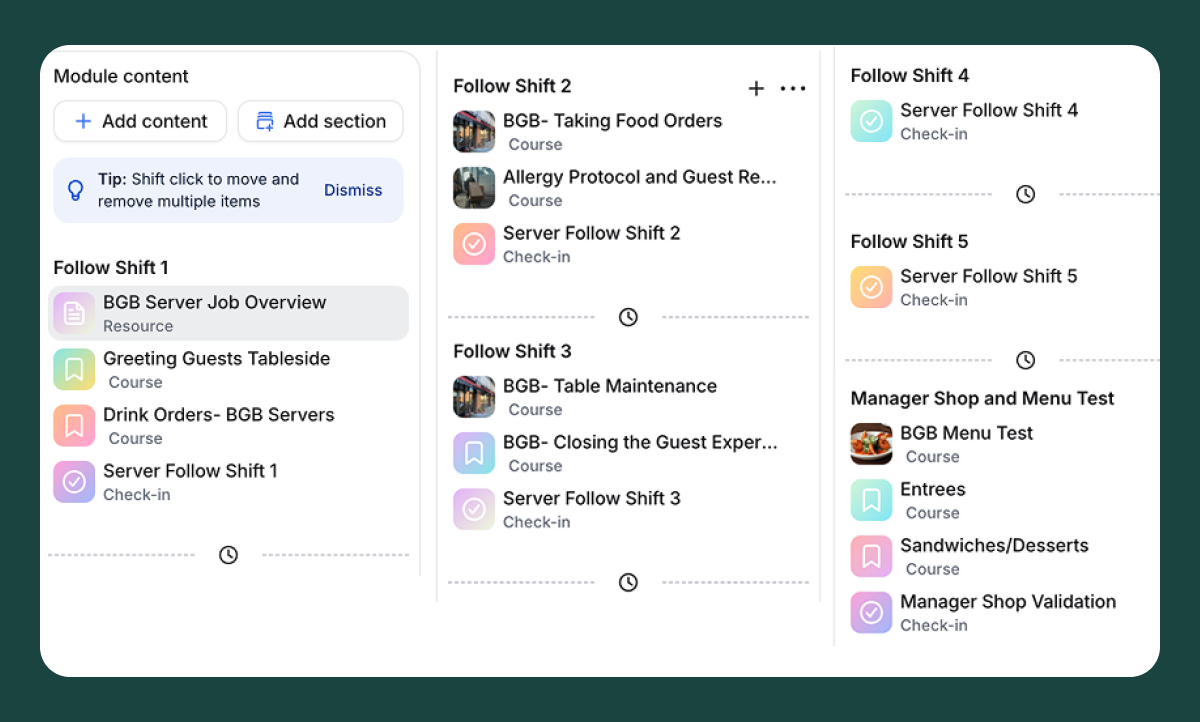
Each shift has a defined purpose — progressing from full passive shadow to running an independent section. Servers complete their Opus courses before the shift; the trainer observes and checks off behaviors throughout.
- Shift 1: Full passive shadow. Completes Opus courses and quizzes, builds the mental model before touching a table.
- Shift 2: Server assistant. Helping with drinks and support tasks — not yet running food or owning tables independently.
- Shift 3: Active participant. Greeting tables, stepping into hospitality moments with the trainer alongside.
- Shift 4: Running with fewer prompts. Taking a table through full steps of service, trainer close but hands-off.
- Shift 5: Independent section. Running 2–3 tables on their own, with the trainer now in the shadow role.
Certification: the management shop
Once the five follow shifts are complete, the server goes through the management shop — waiting on their manager and a certified trainer or colleague, demonstrating full steps of service, allergen knowledge, and hospitality soft skills. This is the final sign-off.
How the training module is built in Opus
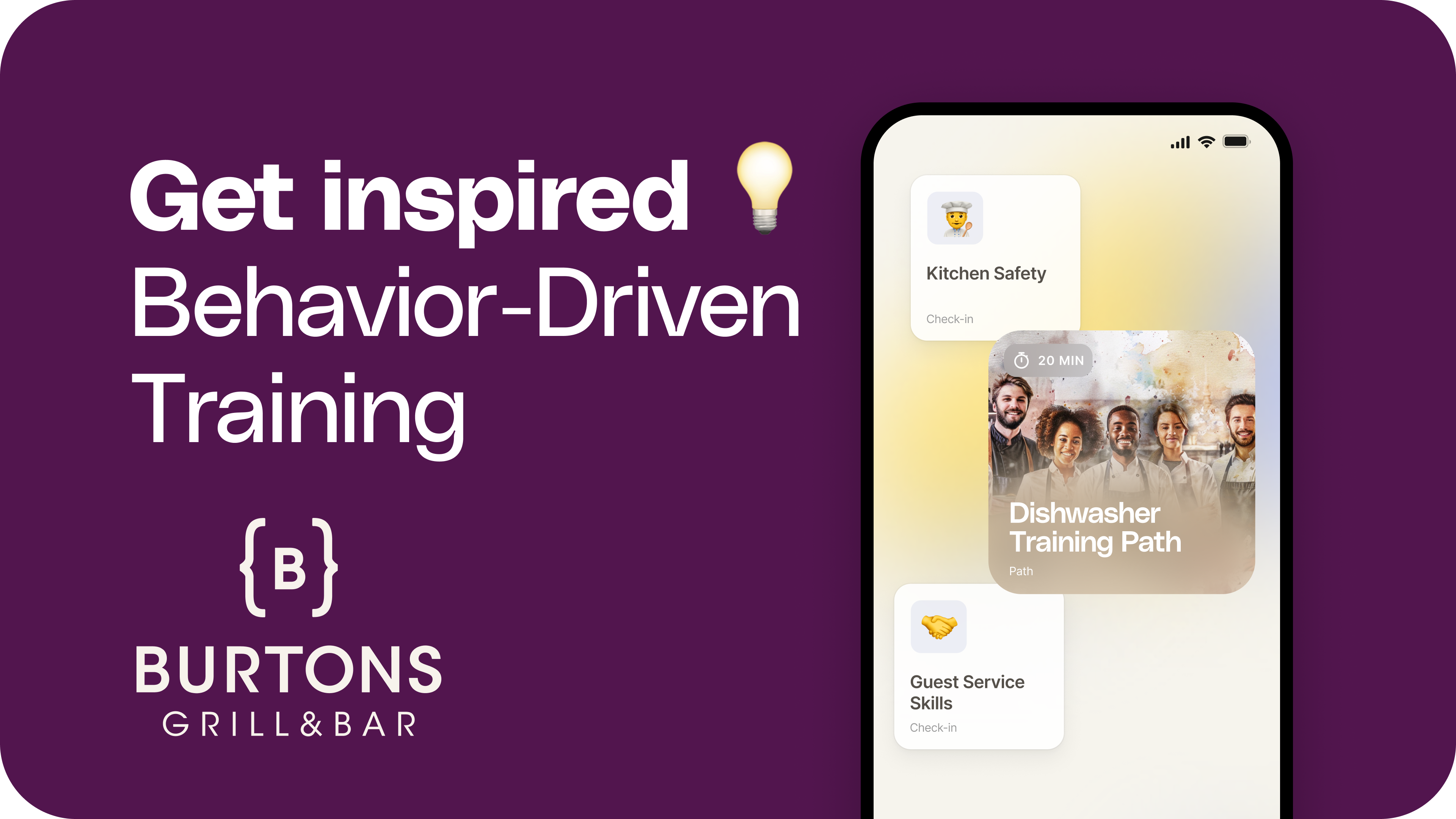
The BGB Server Module follows the guest journey — from being seated to leaving the restaurant — rather than organizing content by job function.
Design choices that make it work
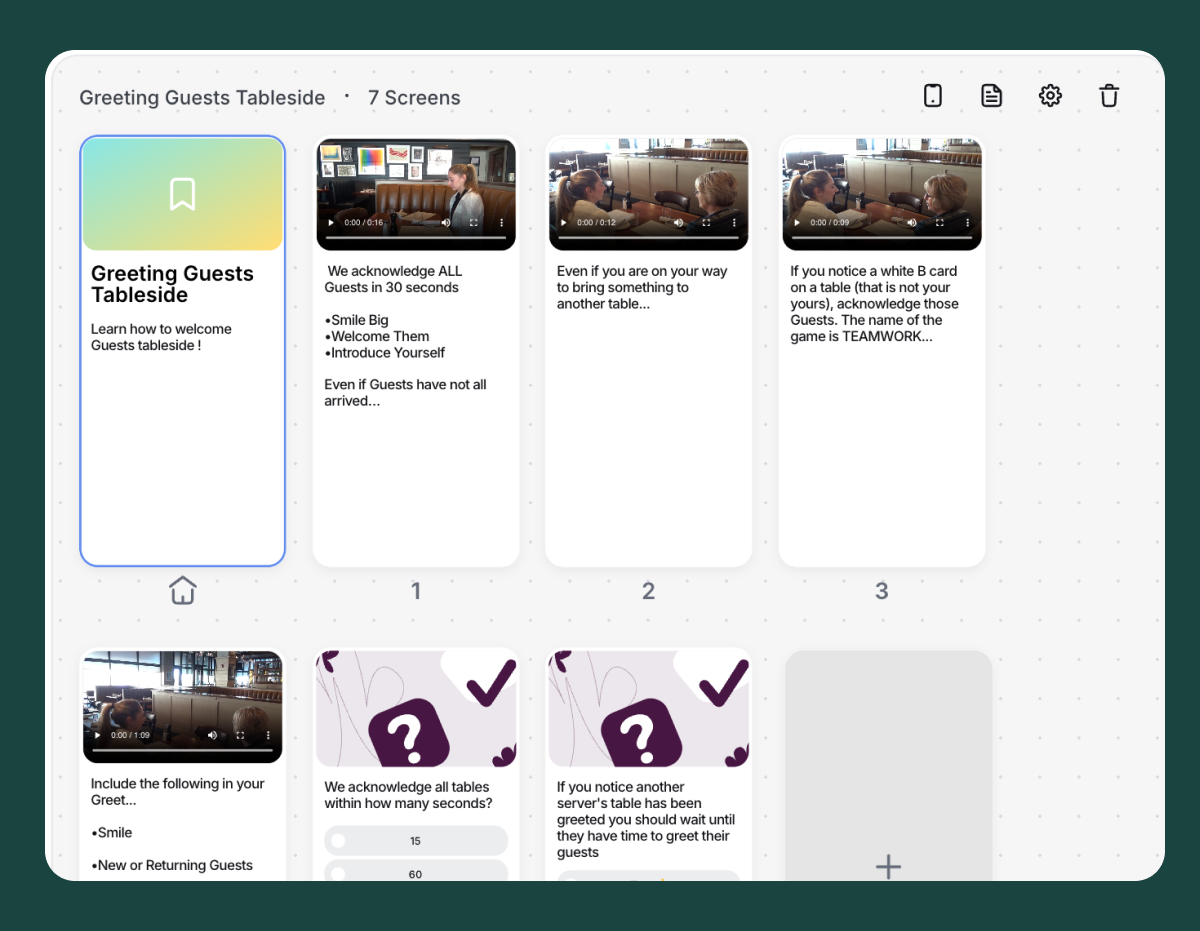
Short videos, one step at a time
Each video covers a single step of service. Servers see soft skills in action — the warm greeting, the hospitality smile — before they're expected to deliver them.
"Everyone learns differently, but at least they're seeing how someone delivers it."
Progression unlocking
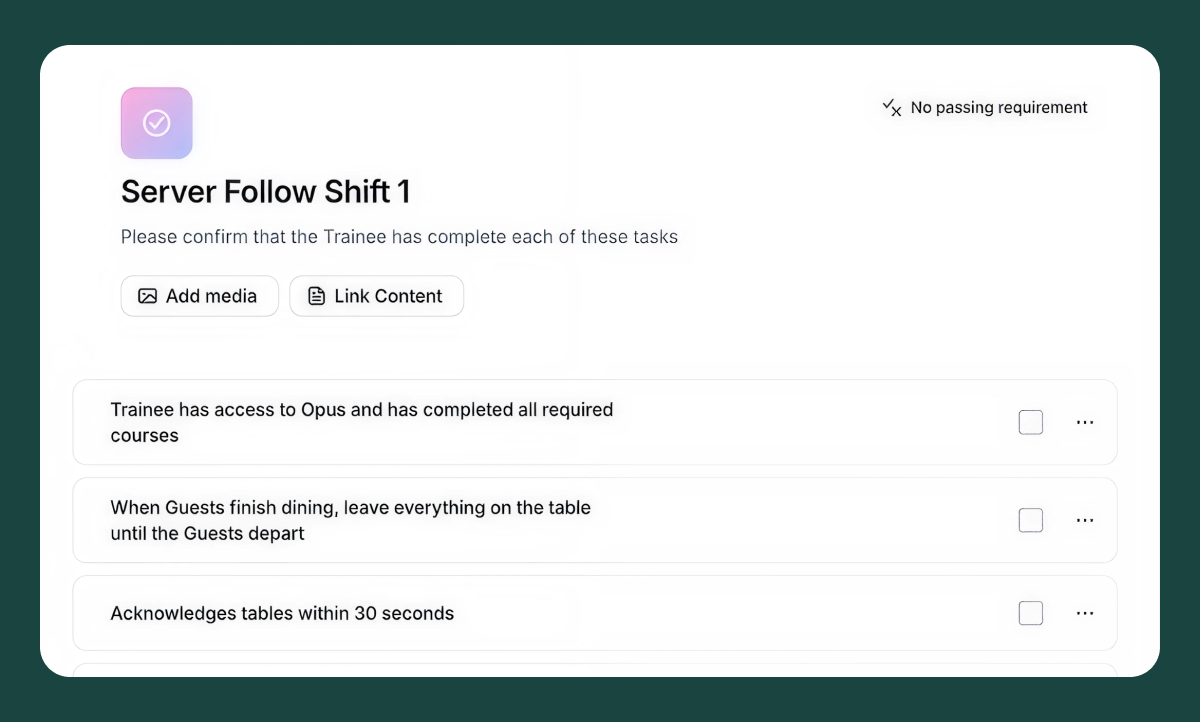
Each follow shift unlocks only after the prior check-in is complete. Servers can't skip steps, and the training team always knows where each person stands.
Check-ins tied to the shift, not the clock
"I don’t want my servers walking around on their phone and their trainers checking these off in real time. That's not a great look."
Trainers observe across the shift and complete the check-in at the end. Managers can complete check-ins themselves or delegate to a specific trainer for a specific shift, keeping oversight in place without creating a bottleneck.
Menu and allergen reference always accessible
The full menu deck stays in the resource library throughout training and beyond. Servers use Ask Opus, in-app AI search, for real-time allergen lookups mid-service. Across Burtons' locations, roughly 70% of Ask Opus questions are allergen and ingredient queries, making the tool integral to day-to-day.
"Ask Opus is great, especially for new people, especially with how heavy we are on allergies. If the allergy iPad is being used and you need to check something quickly, you can ask and it will pull it up."
Three things that make Burtons FOH training work
With 94% manager engagement, the program reflects what happens when training is built around habits, not checkboxes.
✅ Set the standard digitally before servers hit the floor.
✅ Keep management engaged, not just present at sign-off.
✅ Make the reference material accessible at the moment of need.
See it for yourself
Read more: To see the “Greeting Guests Tableside” course, scan this QR code below

For more on the FOH service training best practices Jennifer shared, read the full Office Hours recap →
Explore more training examples: View the full collection at opus.so/training-examples
Ready to build a service training program that drives consistency across every location? Let's talk →
.jpeg)