Boston's Pizza is a restaurant franchise with 21 US locations, run by a lean 4-person support center team that oversees a twice-yearly audit program called the Boston's Excellence Review (BER): once announced in Q1, once unannounced in Q4. Each audit is conducted on-site by a Regional Business Consultant (RBC), covering front of house, back of house, food safety, and overall operations.
{{nimesh-patel}}
Audits that flag problems aren't enough
Before Opus, every BER ran on Excel. RBCs walked the floor with a laptop, entering findings manually into a spreadsheet that calculated scores. Results were emailed to franchisees as a PDF.
The process had three limitations:
- No photo record. If a franchisee pushed back — "It was clean when you were here" — there was no photo evidence to anchor the discussion.
- No path from finding to fix. A failed standard had no owner, deadline, or verification step, so the same issue could resurface next cycle.
- Audits consumed the visit. Each BER took three days, leaving little time for the coaching that actually moves the needle.
What Boston’s BER audit covers
The BER is two separate audits conducted back-to-back during each on-site visit: one for front of house, one for heart of house. Together they cover every corner of the restaurant.
- FOH audit (350 points): Covers every guest-facing area of the restaurant, from the parking lot to the restrooms, plus a scored section on manager and team involvement.
- HOH audit (525 points): Covers each kitchen station individually: build, cut, grill, fry, salad, and pasta. Plus storage, sanitation, and food safety standards.
How scoring works
Each step carries a defined point value. The RBC scores each one at the moment of observation and the audit calculates section totals automatically, generating a pass/fail outcome against a set threshold. RBCs can add inline notes to specific steps — giving context to a finding without holding up the audit.
How Boston's cut BER time in half and closed the loop
Audits on mobile, in the restaurant
RBCs now complete the BER on an iPad while walking the floor. What used to take three days takes about one and a half.
"It used to take us three days to complete an audit and now we can get it done in like one and a half. That gives us more time to coach and solve problems with our store teams."
Jalinna Jones, Regional Business Consultant, Boston's Pizza
504 hours of RBC time saved per year
21 locations x 2 audits x 1.5 days saved x 8 hours = 504 hours annually. At a fully loaded RM salary, that is roughly $20,000 in field time given back to coaching.
The team still books three nights per site visit. The recovered time goes back into the restaurant, working shoulder-to-shoulder with store teams during the same trip.
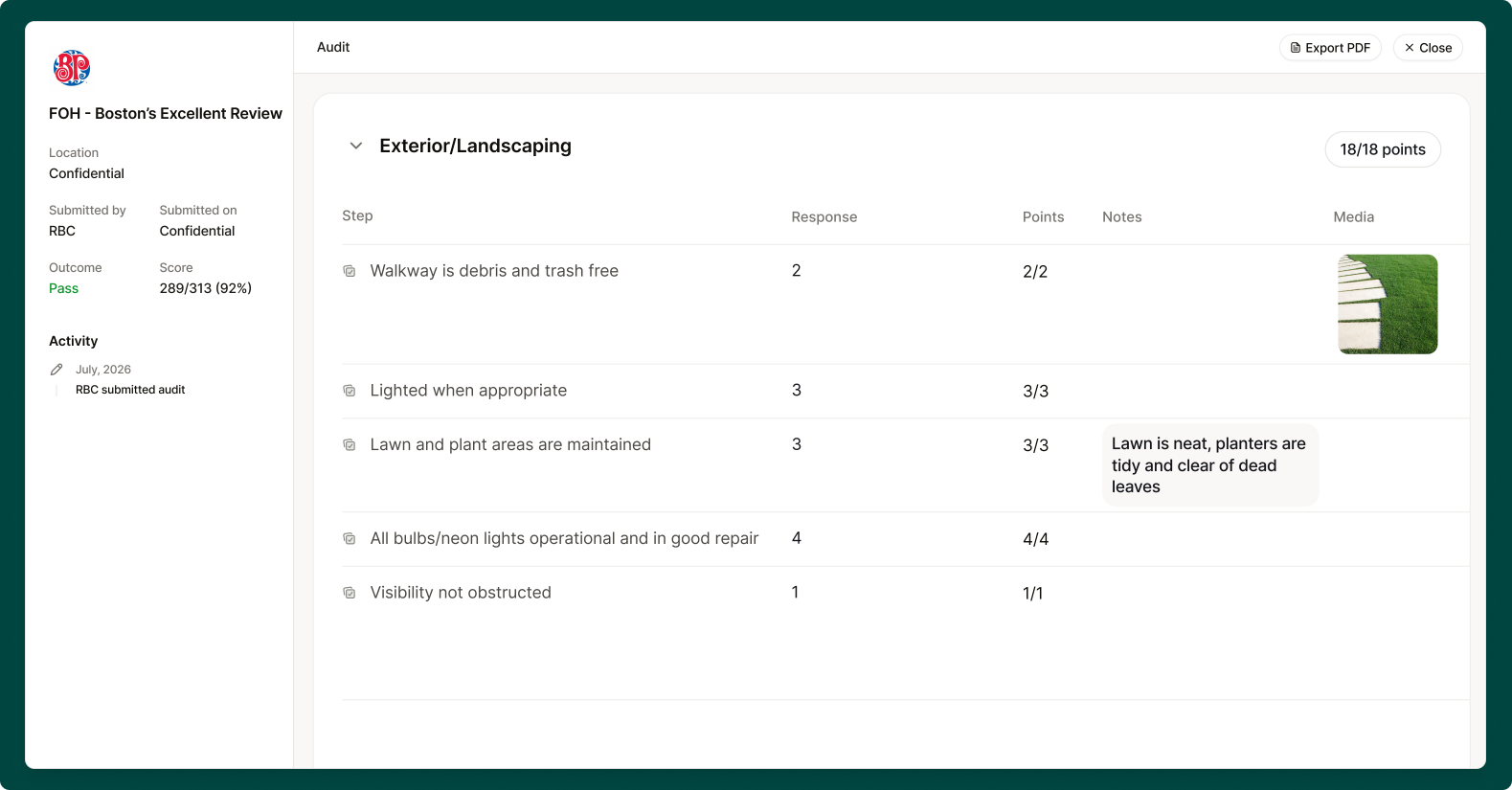
Photo documentation per finding
Boston's attaches photos across three areas: location condition and cleanliness, food storage and safety checks, and equipment requiring visual verification. On failing steps, that photo is the record: timestamped, tied to the specific step, and not disputable. Since moving to Opus, Boston's has had no franchisee pushback on BER findings.
Action items that close the loop
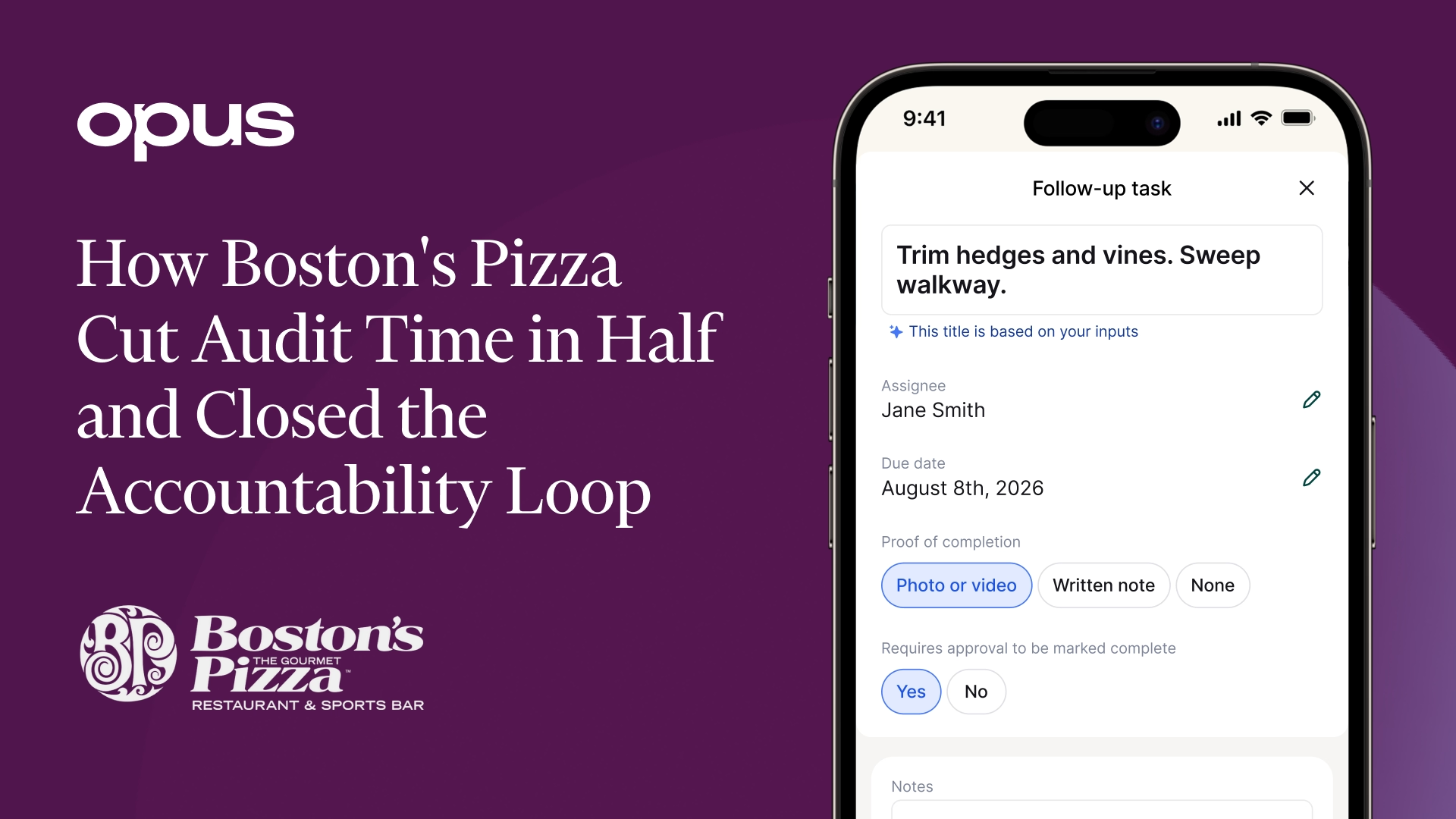
When findings require follow-through, action items are assigned directly from the audit. Each one has an owner, a due date, and a place to document the fix with notes and photos. The auditor reviews and approves the resolution before it closes.
Because store managers are already using Opus for daily task lists and training, action items land in the same app they open every shift. No new tool, no new habit to build. Issues get resolved because they show up where the work already happens.
Results distributed in real time
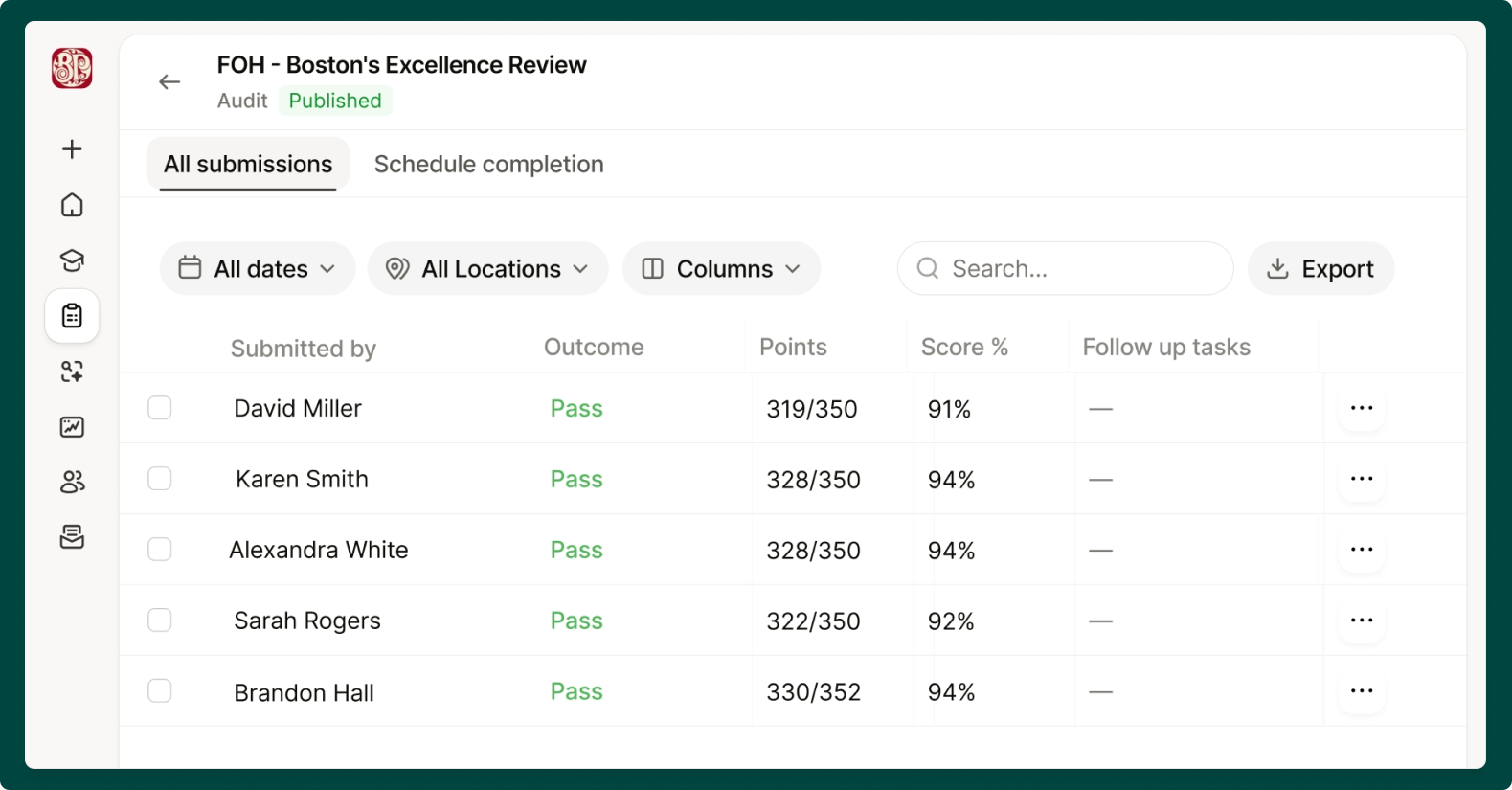
The moment an audit is submitted, results go to the full distribution list: the executive team, the franchise partner, the location's full management team, and internally to marketing, development, and construction. No manual compilation, no PDFs emailed after the fact.
Three things that make Boston's audit program work
With audit time cut in half and franchisee disputes eliminated, the BER is now doing the job it was designed to do.
✅ Document findings at the moment they're observed. Photos taken on mobile at the point of inspection create a defensible record and change the conversation with franchisees entirely.
✅ Give every finding an owner and a deadline. The accountability loop only closes if someone is responsible for the fix. Action items make that built-in, not optional.
✅ Keep everything in one platform. Training, tasks, and audits in one place means the support center is not managing multiple tools or multiple adoption fights across an independently operated franchise network.
See it for yourself
Ready to run audits that actually drive follow-through? Let's talk
Explore more training examples at opus.so/training-examples
.jpeg)